
Issue 10 · July 20, 2026
Brent at $88 Is Not Europe's Real Hormuz Problem. Gas at €59 Is.
Oil just had its most violent week since spring. Brent jumped more than 14% to $88, its highest in a month. And yet the price that should worry Europe most this winter is not oil. It is gas, up 29% in July to a four month high.
This Week · Brent back above eighty eight · Qatar's gas trapped behind Hormuz · Trump's toll gone in a day
Lead Story
Brent at $88 Is Not Europe's Real Hormuz Problem. Gas at €59 Is.
Oil found ways around the strait this week. Qatari gas, a tenth of Europe's supply, has none, and Qatar just stopped sailing.
Brent crude, the global oil price benchmark, settled at $88.10 per barrel on Friday 17 July, up about 4.6% on the day and more than 14% on the week, its highest in a month, after Kuwait said Iran struck a power and water desalination plant and US forces completed a sixth straight night of strikes on Iran. The sharper move was in gas. TTF, Europe's benchmark wholesale natural gas price, settled near €59 per megawatt hour, its highest in nearly four months, up about 15% on the week and roughly 29% across July. The trigger was Qatar halting the ramp up of its LNG, liquefied natural gas chilled to liquid for shipping, after one of its tankers, the Al Rekayyat, was struck leaving the Strait of Hormuz on 7 July.
The asymmetry is the story. Oil can leave the Gulf without ever touching Hormuz, because the United Arab Emirates ships from Fujairah on the Gulf of Oman and Saudi Arabia pumps crude west across its pipeline to the Red Sea. Qatari LNG has no such detour: every cargo must sail through the strait, and Qatar supplies about a tenth of Europe's LNG imports. So while Brent's 14% jump adds several cents to every litre of fuel refined in Europe, the unit of risk the continent cannot reroute is a molecule of gas, landing on storage stuck near 50% with the summer injection season half gone. For a European investor over the next 30 to 90 days the Hormuz crisis reads as a gas shock wearing an oil headline: the number to watch is TTF and your winter heating tariff, not only the petrol pump, because a contested strait pushes gas, not oil, to the level that actually reaches household bills.
Chart · Global LNG through the Strait of Hormuz, by destination
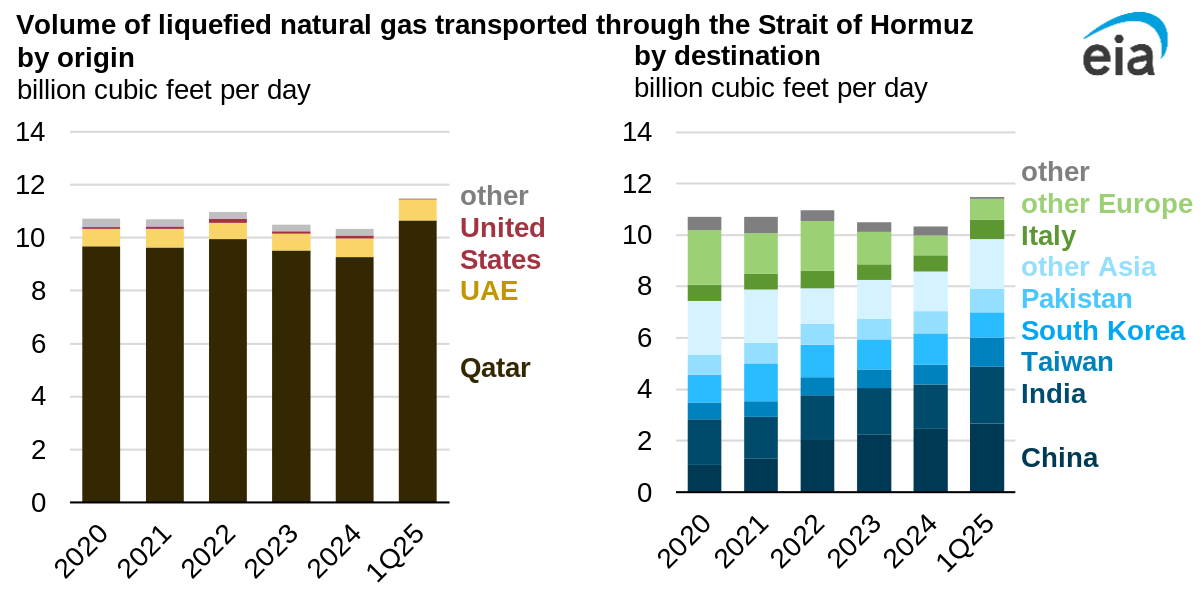
About one fifth of the world's LNG sails through Hormuz, and roughly 93% of Qatar's exports depend on the strait, with about a tenth of Europe's LNG imports riding the same route. Unlike crude, these cargoes have no pipeline detour, so Qatar's decision to pause loadings passes straight to the winter price (EIA, June 2026; IEEFA, 2026).
The unit of risk the continent cannot reroute is a molecule of gas, landing on storage stuck near 50% with the summer injection season half gone.
Geopolitics
The War Premium Now Pays Moscow Twice
Higher crude refills Russia's revenue while Ukraine's drones empty its refineries, and Urals just climbed back to $67.
This week's escalation lifted Urals, the discounted grade Russia actually sells, to about $67 per barrel on 16 July, up roughly 3.6% on the month, refilling the crude revenue that four months of cheaper oil had drained. At the same time Ukraine's drone campaign pushed Russian refinery throughput to its lowest July level in over two decades, striking the Gazprom Neftekhim Salavat and Afipsky plants and forcing crude that Russian refineries can no longer process out to sea, where seaborne exports to Asia reached a post invasion record near 4 million barrels per day in the 28 days to 12 July. So the same Hormuz war premium that raises what a German or Austrian pays to fill a tank also refills the treasury funding the war, even as Ukraine breaks Russia's ability to refine its own fuel. For Central and Eastern Europe the trap sharpens: cheap Russian gas looks rational again exactly when a Hormuz gas shock makes every alternative dearer, and Austria and Germany, holding the deepest exposure, feel that pull first.
In Focus · Tolls
A 20% Tax on the World's Oil, Announced and Cancelled in a Day
Trump's Hormuz toll lasted 24 hours, but the idea that a chokepoint can be taxed did not go away.
The number the market barely priced was 20%. On Monday 13 July President Trump said the United States would charge a 20% fee on all cargo transiting Hormuz, roughly $30 million on a full supertanker, as reimbursement for securing the strait, and would reimpose its blockade of Iranian ports. By Tuesday he had dropped the fee, replacing it with promised trade and investment deals from Gulf states, and the International Maritime Organization said there was no legal basis for a mandatory toll. A Bloomberg terminal saw a one day headline. The structural point it flagged is that the world's most important oil and gas chokepoint can now be treated as a tollbooth by the power that patrols it, not only as a target by the power beside it, and a strait that can be taxed from both sides carries a premium that does not fully leave when the shooting stops.
Take Action
Five Signals to Watch This Week
Concrete checkpoints between now and the next issue.
- Read the EIA Hormuz LNG breakdown at eia.gov. About one fifth of global LNG and a tenth of Europe's imports transit the strait, so the destination split tells you how much of Europe's winter gas rides a route with no pipeline detour.
- Set TTF alerts at €50 and €65. TTF at €59 already cleared Crude's €55 winter target in July, so a hold above €55 confirms the gas shock arrived early and €65 is where full winter supply fear enters the price before the heating season starts.
- Track Brent at $85 and $92. A hold above $85 keeps the reinstated war premium intact, while a slide back under $80 signals the market believes the oil routes around Hormuz are holding.
- Watch the AGSI+ storage dashboard at agsi.gie.eu. With EU storage near 50% and the injection season half gone, each week the fill rate lags the five year band is a week of winter risk the Qatar halt made harder to close.
- Check your gas and utility exposure. If you pay a variable heating tariff or hold European utilities, a contested Hormuz plus a Qatari ramp up on pause is a fourth quarter price risk, so review fixed versus variable options while gas is cheaper than it will be in January.