
Issue 09 · July 13, 2026
Brent Is Back at $76 Because the Peace That Priced the Glut Just Collapsed
Brent just posted its first weekly gain in five weeks, closing near $76 on Friday. The largest oil surplus since the pandemic is still sitting in the IEA's 2027 forecast, unchanged.
This Week · Brent's $76 breakout · Moscow's crude rebate · Barrels stuck at sea
Lead Story
Brent Is Back at $76 Because the Peace That Priced the Glut Just Collapsed
The entire bearish case rested on a ceasefire. Trump declared it over on Wednesday, and the war premium walked straight back into the price.
Brent crude, the global oil price benchmark, settled near $76 a barrel on Friday 10 July, up about 6% on the week and its first weekly gain in five. That is a decisive break above the $72 floor Crude has defended since late June. West Texas Intermediate, the main US benchmark, settled near $71.40, and TTF, Europe's benchmark wholesale gas price, touched a one month high of €50 per megawatt hour on Thursday 9 July before easing to about €49.5, up roughly 9% on the week. The cause was not supply or demand data. It was the collapse of the US-Iran ceasefire: President Trump declared the truce over on 8 July, the two sides traded fresh airstrikes with the US hitting about 140 Iranian military targets in a third round of strikes, and tanker traffic through the Strait of Hormuz, the chokepoint that carries around a fifth of the world's oil, ground to a halt again. Prices jumped more than 7% on the day the ceasefire was declared dead.
Here is what a European investor should sit with. The International Energy Agency, the Paris body whose monthly report anchors the market, spent June building the bearish consensus: a 4.62 million barrels per day global surplus in 2027 against an 860,000 barrels per day deficit in 2026. In its July report the IEA attached one caveat that everyone skimmed past. The surplus forecast is contingent on a swift de-escalation and the strait returning to full operation. That assumption died on Wednesday. The entire case for oil falling to Citigroup's $60 year end target rested on a peace that no longer exists. The gap between the glut on the IEA's spreadsheet and the $76 on the screen is not a modelling error; it is the market repricing the war the model assumed away. Over the next 30 to 90 days the position is straightforward: as long as the ceasefire stays collapsed and Hormuz traffic is disrupted, Brent holds above $76 and the path runs toward the $80s, not the $60s. Every litre of European fuel now carries a reinstated war premium, and the calm that let households enjoy cheap petrol in early July is gone.
Chart · Brent Crude Front Month, Mid June to 10 July 2026
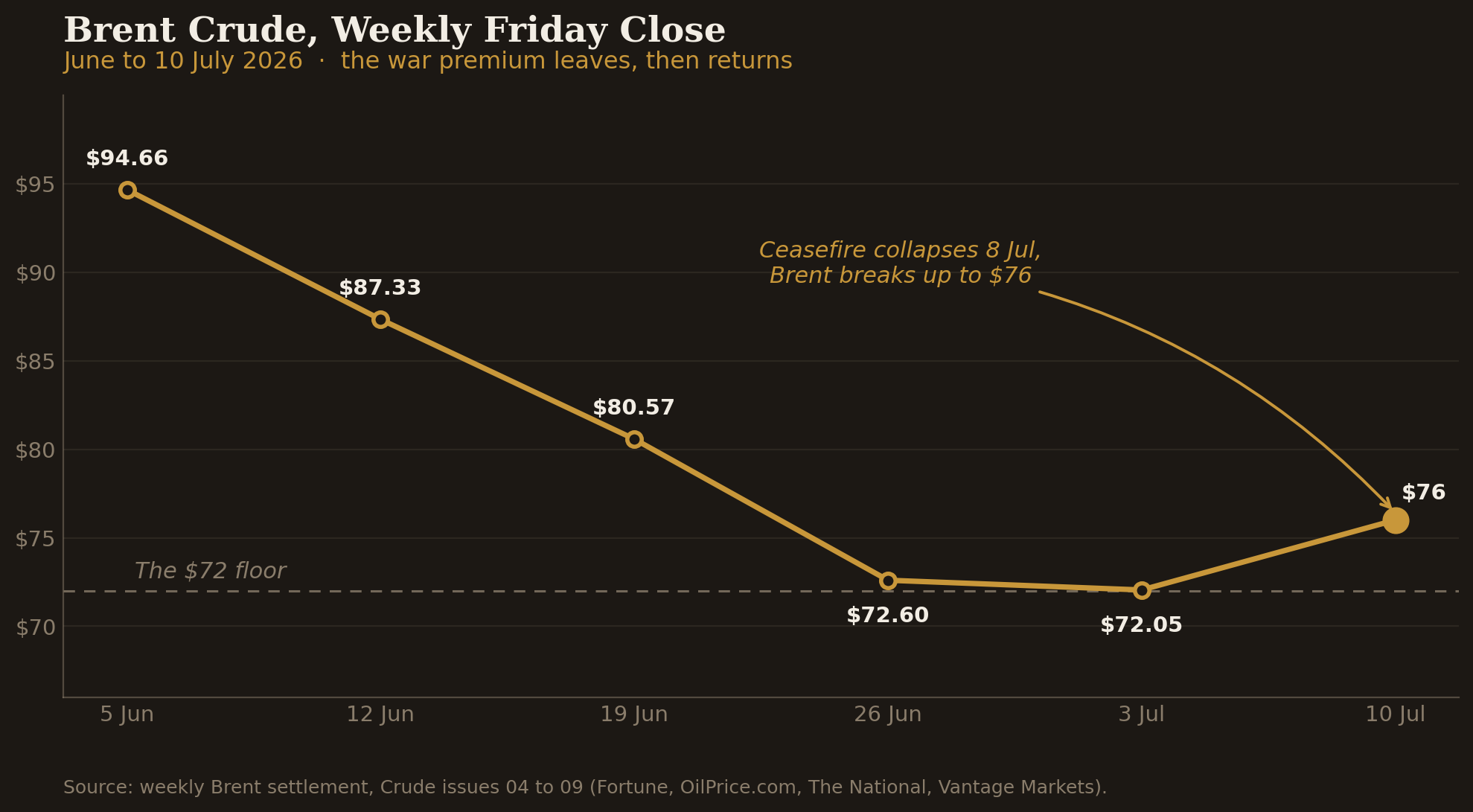
Brent round-tripped down to its pre-war $72 by late June, held that floor for two weeks, then broke sharply back above $76 in the week to 10 July as the ceasefire collapsed. The V is the war premium leaving and returning inside a single month, and the right hand side of the chart is the part no glut forecast can model. Source: Trading Economics, 10 July 2026.
As long as the ceasefire stays collapsed and Hormuz traffic is disrupted, Brent holds above $76 and the path runs toward the $80s, not the $60s.
Geopolitics
The War Premium That Refills Moscow's Coffers
The ceasefire collapse punishes Europe at the pump and hands the Kremlin a crude rebate in the same week.
For months the pressure on Russia ran one way. Ukraine's drone campaign, which Crude has tracked through the spring, was draining Moscow's fuel machine faster than any sanction, and the falling oil price was quietly compounding it by cutting the revenue on every barrel Russia still sold. This week that reversed. The same ceasefire collapse that pushed Brent to $76 also lifted Urals, the discounted grade Russia actually exports, refilling the crude revenue that four months of cheaper oil had been eroding. The campaign itself has crossed a new line rather than merely continued: with roughly 42.7% of Russian refining capacity offline by Ukraine's account and fuel output down about a quarter on the year, Moscow has banned diesel exports to the end of the month and started importing gasoline from India, Kazakhstan and Belarus, an extraordinary position for a country that sells energy to the world. That is the uncomfortable European consequence. The war premium now raising what Austrians and Germans pay at the pump is the same premium refilling the treasury that funds the war, and the cheap oil that was doing half the work of Ukraine's strikes has vanished in a single week. For Central and Eastern Europe the squeeze that was biting on two sides now bites on one, and Austria and Germany, holding the deepest exposure to Russian supply, feel the reversal first.
In Focus · Flows
The Barrels Are Stuck Again
About 63 million barrels sit at sea while the one Gulf producer that skips Hormuz prints records.
The under-covered number this week is not a price, it is a location. Roughly 63 million barrels of crude are now stranded at sea after the United States pulled Iran's sanction waiver and tanker traffic through the Strait of Hormuz halted following the escalation. While those cargoes wait, the United Arab Emirates, which left the OPEC+ producer group on 1 May and can export from Fujairah on the Gulf of Oman without ever entering Hormuz, pushed output to an all time high above 3.8 million barrels per day in June, roughly double its pre-crisis level. A Bloomberg terminal reader saw the 7% price spike in real time. The point the coverage missed is structural: the only Gulf barrels moving freely are the ones that never touch the chokepoint, and that is now a map of where Europe's marginal supply security actually lives. Every cargo that has to transit Hormuz is a barrel exposed to a war that just restarted, and the premium on the ones that do not is only going to widen.
Take Action
Five Signals to Watch This Week
Concrete checkpoints between now and the next issue.
- Read the IEA July Oil Market Report at iea.org. Its 2027 surplus forecast is explicitly conditional on de-escalation, so the August report is the single document that will tell you whether the glut thesis survives the ceasefire collapse.
- Track Brent at $76 and $80. A hold above $76 confirms the floor broke upward rather than down, and $80 is the level where the reinstated war premium is fully back in the price.
- Watch Hormuz tanker traffic and any revived Switzerland talks. A genuine return of transit or a real ceasefire is the one event that resurrects the surplus narrative and sends Brent back toward $70.
- Follow Urals crude and Russia's diesel export ban together. A rising Urals price alongside a fuel export ban is the clearest live picture of the war premium funding the war economy it is meant to starve.
- Check your fuel and utility exposure. With Brent and TTF now rising on the same Hormuz risk, review fixed versus variable energy tariffs while the re-escalation is still fresh rather than after it is priced.