Issue 11 · July 27, 2026
Brent Broke $100 on Three Chokepoints. Only One Answers to Washington.
Brent crude broke $100 on Thursday for the first time since May. It did it in the same week that Pakistan and China started pushing the United States and Iran back toward peace talks.
This Week · Brent breaks $100 · Ukraine strikes Black Sea oil · Gas at a January 2023 high
Lead Story
Brent Broke $100 on Three Chokepoints. Only One Answers to Washington.
The Hormuz premium can leave on a ceasefire. The Black Sea premium Ukraine just opened cannot.
Brent crude, the global oil price benchmark, settled at $97.72 a barrel on Friday 24 July 2026, down almost 3 percent on the day but up about 10 percent on the week, after topping $100 on Thursday for the first time since May. The rally was not one story but three arriving together. Traffic through the Strait of Hormuz, the Gulf channel that normally carries a fifth of the world's seaborne oil, fell to a single tanker crossing on Thursday, the fewest since 7 May. At least one Saudi tanker was struck in the Red Sea, extending the war to the Bab al-Mandeb strait at the far end of the Arabian Peninsula. And on 19 July drones hit two tankers at the Caspian Pipeline Consortium terminal near Novorossiysk on Russia's Black Sea coast, forcing the operator, known as CPC, to suspend every loading. Kazakhstan, whose crude fills more than 80 percent of that pipeline, cut national output 21 percent on 22 July to 1.63 million barrels a day from a July average of 2.07 million, with its giant Tengiz field down 56 percent.
The market read Friday's near 4 percent drop as the top, on reports that Pakistan and China were pushing to revive talks between Washington and Tehran. That read is wrong, and here is why it matters for a European with an energy bill and a brokerage account. A deal between the United States and Iran can reopen Hormuz and lift the Red Sea threat, because both hang on Tehran. It cannot reopen the Black Sea, because Ukraine opened that front and Ukraine answers to no one in that negotiation. For the first time the oil premium rests on three separate chokepoints controlled by three different actors, and no single ceasefire removes all three. Goldman Sachs still models Brent at $80 for the fourth quarter on the assumption that the Middle East calms by year end, yet flags that Brent runs above $120 if Hormuz stays shut. The screen at $97.72 already sits about $18 above that base case, and that gap is the market pricing the one thing the model assumes away. Brent holds above $90 over the next 30 to 90 days even if the United States and Iran sign, because the Ukrainian front stays open regardless. The path from here runs toward Goldman's $120, not back to the $72 floor of June. For Europeans that means fuel and heating costs stay elevated into autumn and the cheap oil window of early summer is closed.
Chart · Brent Crude Breaks $100
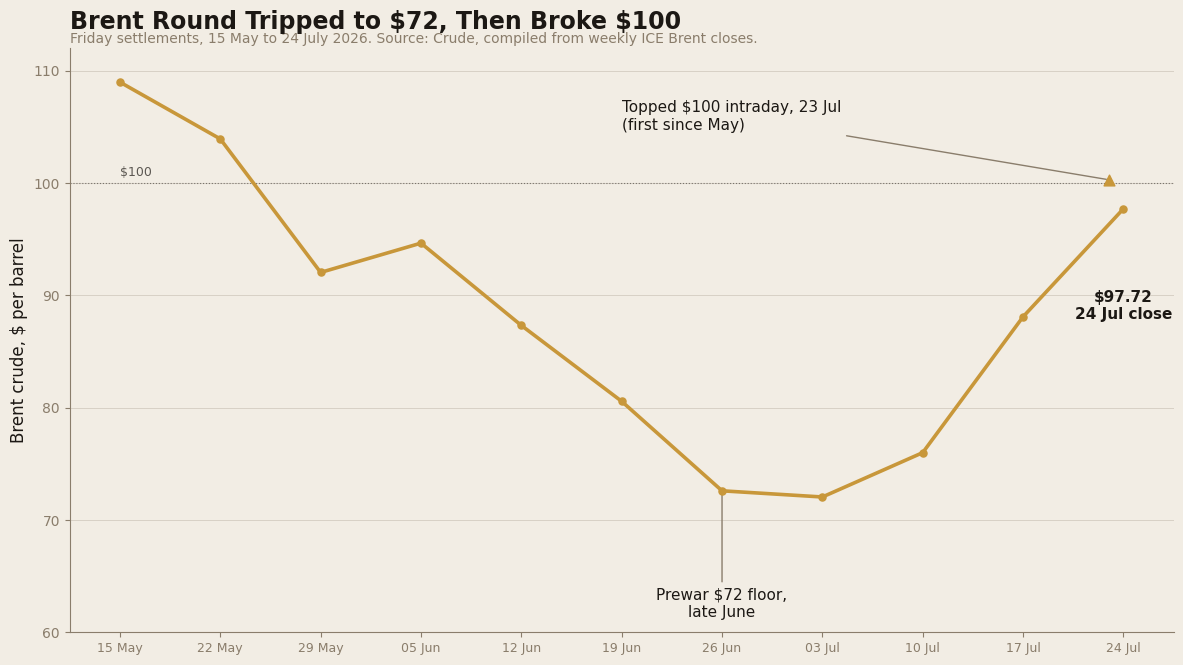
Brent's leap above $100 on 23 July was the first triple digit print since May, and it came not from a fresh Hormuz event but from the third chokepoint opening in the Black Sea, which is why a partial Middle East thaw does not fully reverse it. Source: Trading Economics, 24 July 2026.
A deal between the United States and Iran can reopen Hormuz. It cannot reopen the Black Sea, because Ukraine opened that front and Ukraine answers to no one in that negotiation.
Geopolitics
Ukraine Moved Its Drone War From Russian Refineries to the Black Sea. Kazakh Oil Is the Collateral.
The campaign that starved Moscow's budget now strands a barrel Chevron and ExxonMobil own and Tehran never touched.
Ukraine's General Staff says its forces targeted 124 vessels linked to Russia, including 89 tankers, between 8 and 20 July across the Black Sea and the Sea of Azov. The strike that moved the oil market was the one on 19 July at the Caspian Pipeline Consortium terminal near Novorossiysk, which handles about 2 percent of global crude supply and more than 80 percent of Kazakhstan's exports, and in which Chevron holds 15 percent and ExxonMobil 7.5 percent. Russia's own Sheskharis terminal has loaded no crude since 21 July, taking a further 650,000 barrels a day off the water. This is the moment Ukraine's war reached past Russia's budget and into the physical global supply chain, and the European consequence cuts two ways. It drains Russian export revenue by volume, not just by discount, which is what four years of sanctions failed to do. Yet it also strands Kazakh crude, a non combatant Western invested barrel, and a squeezed Kazakhstan with no quick reroute leans harder on Moscow and Beijing for the pipelines it has left. Europe cheers the pressure on the Kremlin while paying for it at the pump and watching Central Asia drift further from its orbit.
In Focus · Tankers
The Number the Price Screen Hides: One.
One tanker crossed Hormuz on Thursday. The war risk surcharge, not the barrel, is now the market.
The figure that tells the story is not the $100 headline but the count of ships. A single tanker crossed the Strait of Hormuz on Thursday 24 July, the fewest since 7 May, and Goldman estimates Gulf flows have fallen below 45 percent of their prewar level. At the same time the Nordic Zenith, a Suezmax class crude tanker, was hit twice while anchored off the Caspian Pipeline Consortium terminal, the kind of strike that empties an anchorage overnight. What is repricing oil is no longer the number of barrels in the ground but the war risk surcharge, the extra insurance and freight a shipowner charges to sail a contested strait, and that surcharge is now stacking across three seaways at once. A Bloomberg terminal shows you the flat price. It does not show you that the marginal barrel is being set by underwriters in London deciding whether a hull is insurable at all. For a European investor the signal to watch is not Brent itself but tanker rates and war risk premiums, because when those ease the flat price follows, and until they do the $90 floor holds.
Take Action
Five Signals to Watch This Week
Concrete checkpoints between now and the next issue.
- Watch the Caspian Pipeline Consortium loading status. A resumption of crude loadings at Novorossiysk and Sheskharis is the first hard signal the Black Sea premium is leaving, ahead of any price move.
- Track Brent's $90 line specifically. A hold above $90 on ceasefire headlines confirms the market is pricing three chokepoints, not one; a clean break below $90 says a single front is enough to unwind the premium.
- Read Goldman's split scenario. The base case is $80 for the fourth quarter and the upside is above $120 if Hormuz stays disrupted, with Gulf flows against 45 percent of prewar the trigger between them.
- Monitor EU gas storage on the AGSI+ tracker at agsi.gie.eu. Storage near 53.67 percent sits about 15.59 points below the five year average, and the August injection pace decides winter exposure.
- Check your energy exposure to the Black Sea, not just the Gulf. Chevron and ExxonMobil carry direct stakes in the disrupted CPC route, and it is worth researching whether Kazakhstan's forced cut pushes Astana closer to Russia and China.