
Issue 01 · May 18, 2026
The Deficit Outlasts Any Deal
Depleted inventories mean high prices outlast any ceasefire. The math does not forgive.
This week: Brent near $109 · Record global inventory drawdown · EU gas storage crisis
Lead Story
Depleted Inventories Mean High Prices Outlast Any Ceasefire
The math does not forgive
Brent crude, the global oil price benchmark, settled near $109 per barrel on Friday 16 May 2026, a weekly gain of 8.1%. TTF, Europe's wholesale natural gas benchmark, closed near €50 per megawatt-hour, a weekly rise exceeding 11%. Both moves traced to the same source: the International Energy Agency (IEA, the Paris-based body that monitors global oil and gas supply) published data on 13 May showing global oil inventories fell by 246 million barrels across March and April combined, the steepest two-month drawdown on record.
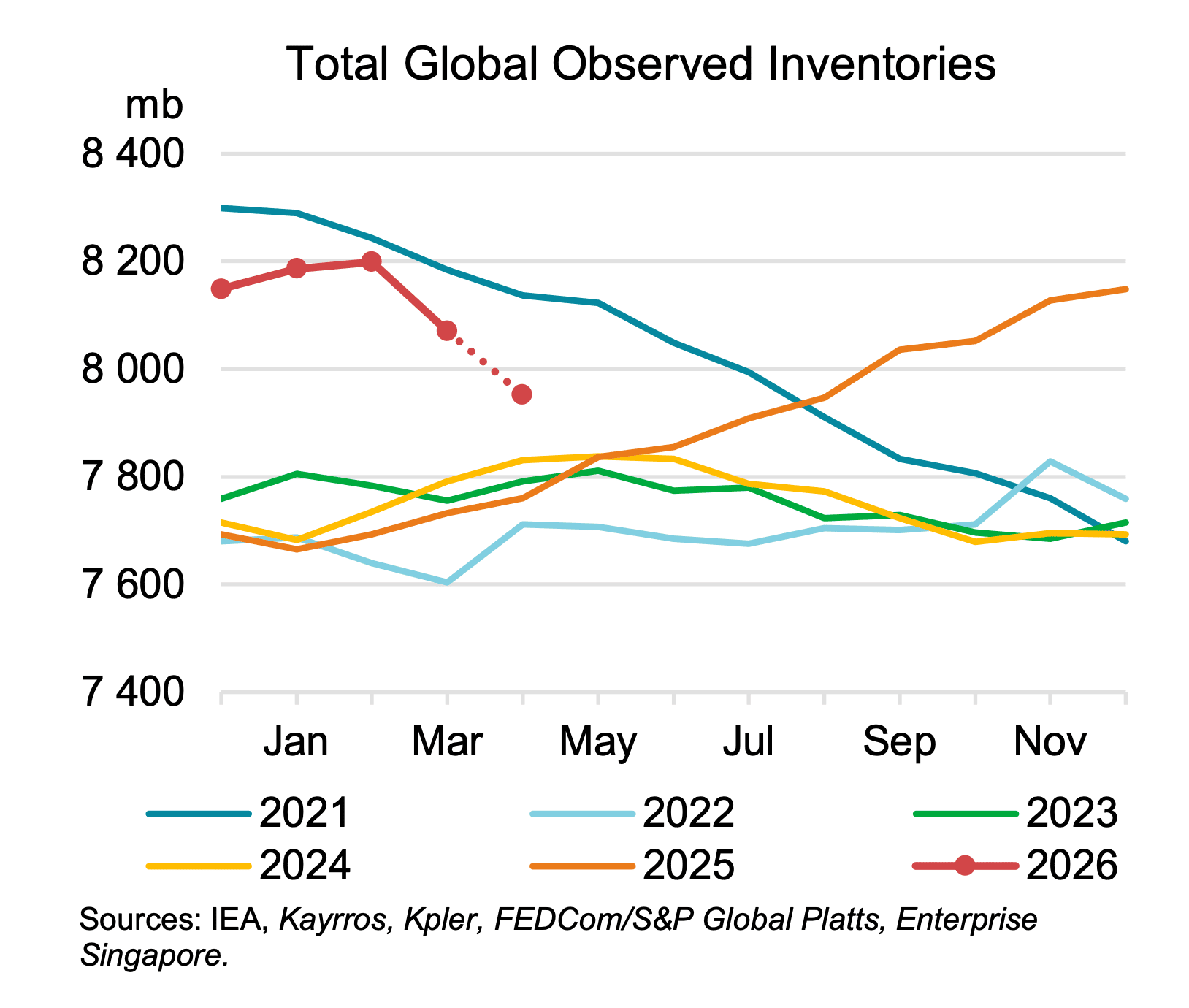
The IEA's base case projects the market severely undersupplied through the end of Q3 2026 even if the conflict ends in early June. Demand outpaces supply by 1.78 million barrels per day this year. A modest Q4 surplus barely dents the accumulated deficit, leaving the market tight well beyond 2026.
For European investors: structurally higher fuel costs and energy bills through at least the end of the year. A ceasefire does not change the inventory arithmetic.
Geopolitics
Beijing Agreed on Hormuz and Offered No Mechanism
Statements without action cost Europe
At the Beijing summit on 14 to 15 May 2026, Presidents Trump and Xi agreed the Strait of Hormuz must reopen but offered no mechanism to enforce it. China refused to commit to pressuring Iran directly. The Hormuz closure has now eliminated around 14 million barrels per day of Gulf oil supply with no diplomatic path to resolution.
Europe is absorbing the direct cost: EU imports of Russian Arctic liquefied natural gas (LNG, gas that is supercooled and shipped by tanker) from the Yamal terminal hit 6.69 million tonnes in the first four months of 2026, up 17.2% year on year, as European buyers replace lost Qatari volumes with every available cargo.
In Focus: Storage
Europe Enters Injection Season at Historic Storage Lows
Winter 2026 to 2027 risk rising
European gas storage entered the injection season (the period when operators rebuild winter reserves) at 34.3% of capacity in May 2026, roughly 20 percentage points below the five-year seasonal norm. The daily injection rate now required to reach the EU's mandatory 80% fill target by 1 November exceeds any pace achieved in the past five years.
Qatari LNG is offline after Iranian strikes on Ras Laffan, Qatar's main LNG export complex. Russian pipeline gas has been absent since 2022. This is structurally the hardest gas refill season since 2018. European households will pay the difference in their winter 2026 to 2027 energy bills.