
Issue 06 · June 22, 2026
Brent at $80 Is the War Premium Leaving. The Glut Has Not Even Arrived.
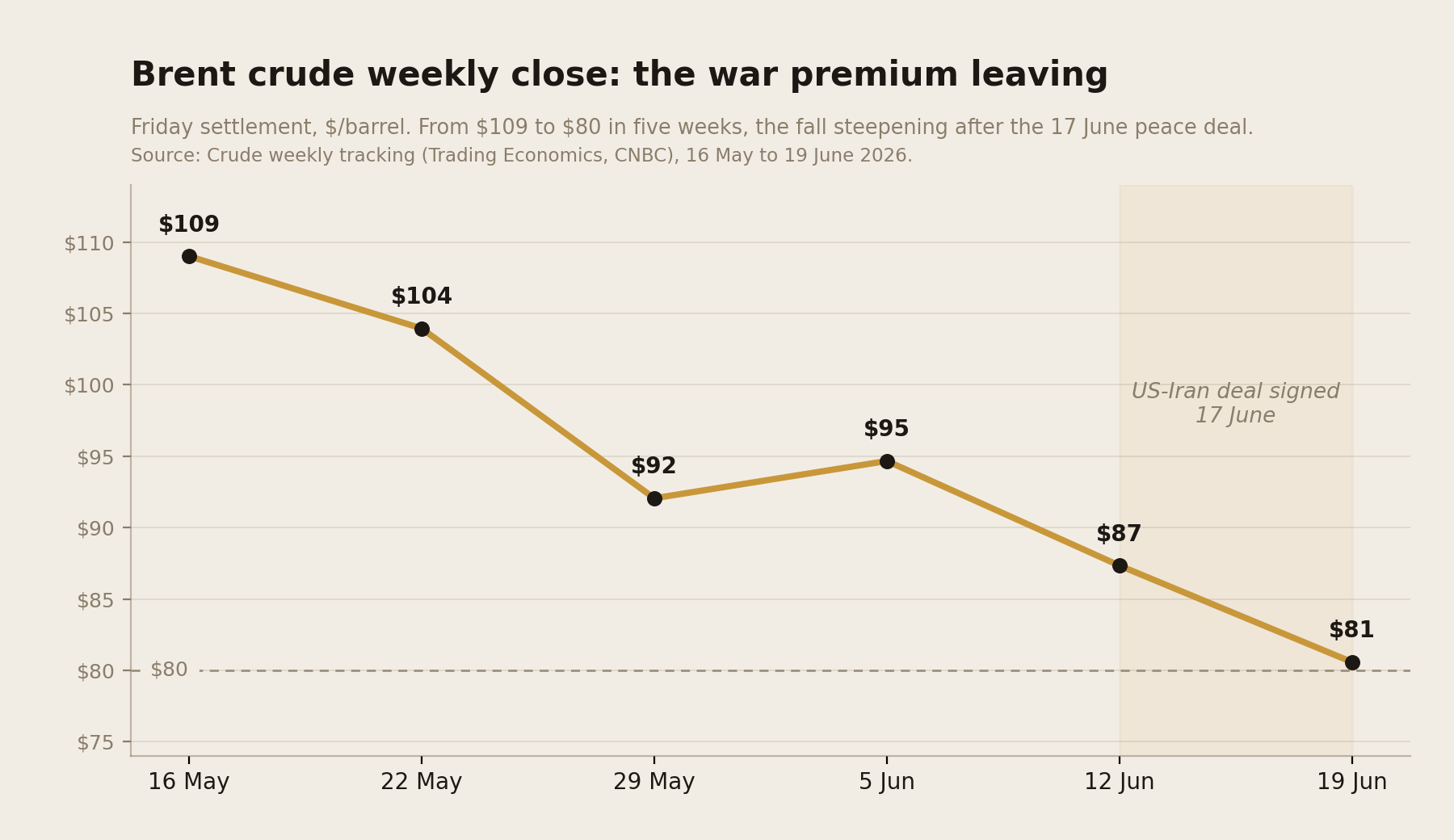
On June 17 the United States and Iran signed a peace deal to reopen the Strait of Hormuz, and Brent crude fell to $80, an eight percent drop on the week. As of June 20, not a single commercial tanker had sailed east through the strait.
This Week · The paper peace at Hormuz · The IEA glut verdict · Moscow refineries under fire
Lead Story
Brent at $80 Is the War Premium Leaving. The Glut Has Not Even Arrived.
The peace deal is signed and not one extra barrel has sailed. When the tankers move in July, the floor is the $70s, not $80.
On Friday 19 June Brent crude, the global oil price benchmark, settled at $80.57 a barrel, up under one percent on the day but down about eight percent on the week, and dipped below $80 for the first time since the conflict began. The fall had one trigger. On 17 June the United States and Iran signed a memorandum to end the war and reopen the Strait of Hormuz, the chokepoint that carries a fifth of the world's seaborne oil and has been shut since February, with Donald Trump putting his name to it after the G7 summit at Versailles. European wholesale gas eased in step: TTF, the benchmark price for natural gas in Europe, settled at EUR 42.06 per megawatt hour, down about ten percent on the week and almost fifteen percent on the month. Here is the part the headlines skipped. As of 20 June not one commercial tanker had sailed east through the strait, and roughly fifty supertankers still sat waiting off the Gulf. The price collapsed on a supply recovery that has not physically happened.
That sequence settles an argument Crude has run since May. If the price falls the week peace is signed, before a single extra barrel moves, then the price was never about supply. It was about demand, and demand is breaking. On 17 June the IEA, the International Energy Agency that publishes the most watched monthly oil data, cut its 2026 global demand forecast to a decline of 1.1 million barrels a day, a downgrade of 700,000 barrels in a single month, after second quarter deliveries fell five million barrels a day against last year, and its own analysts reframed the year from supply shock to oil glut. For a European investor the read for the next 30 to 90 days is to stop treating $80 as a floor. The roughly fifty tankers waiting off the Gulf will clear in July and land Gulf crude into that glut, and Goldman Sachs has already cut its fourth quarter Brent call to $80 from $90. The honest base case is Brent undershooting toward the low $70s by the third quarter, which reaches European pumps and heating bills as cheaper fuel, not because supply healed but because the world stopped buying. The one risk that inverts this is the deal itself breaking, and the follow on talks in Switzerland were postponed on 19 June, the reason Brent ticked up on Friday rather than falling further.
Chart · IEA June Balance, From Deficit to Glut
The IEA's June report cuts 2026 global oil demand to a 1.1 million barrel a day decline after second quarter deliveries fell five million barrels a day year on year, framing the year as a move from supply shock to oil glut. The price fell to $80 the same week, which is the point: a market swinging into surplus does not wait for the tankers to sail (IEA Oil Market Report, 17 June 2026).
The price collapsed on a supply recovery that has not physically happened.
Geopolitics
Ukraine Took the War to Moscow's Refineries as the G7 Watched
Cheap oil and a fuel crunch squeeze Russia at once, yet the low price quietly erodes Europe's resolve to leave Russian supply.
On 18 June, while G7 leaders met, Ukraine flew one of its largest drone raids of the year into the Russian capital and struck the Moscow Oil Refinery nine miles from the Kremlin, the second hit on that plant in a week, and set the Kuibyshev refinery alight under a swarm of twenty nine drones. Russia now has more than a million barrels a day of refining capacity offline, a fuel crunch deep enough that Moscow has banned gasoline exports until 31 July, halted jet fuel exports since 1 June, and begun rationing petrol in occupied Crimea. The European consequence runs two ways. A Russia that cannot refine its own fuel is now also selling its crude near $80 rather than the $105 the war briefly bought it, a double squeeze on the war economy that four years of sanctions never delivered. The trap for Central and Eastern Europe is that the same cheap oil that punishes Moscow also erodes the economic case for the costly break from Russian supply, the Gdansk reroute and the LNG cargoes of earlier issues, and Austria and Germany, carrying the deepest exposure, feel that pull first.
In Focus · Tankers
The Reopening Everyone Priced Has Not Physically Begun
Around fifty supertankers wait off the Gulf while not one sails east.
The number the relief headlines ignored is a tanker count. As of 20 June, with the peace deal three days old, not one commercial vessel was moving east through the Strait of Hormuz, and Sparta Commodities counted forty eight supertankers open for Gulf loading on 10 June, with roughly fifty more waiting offshore, enough to cover barely two weeks of Middle East exports once they move. The mechanics matter for the price. A reopening does not flip a switch. Buyers front run the restart by booking tankers now, which sends VLCC charter rates, the cost of hiring a very large crude carrier, sharply higher in the first weeks and briefly makes Gulf barrels more expensive to move, not less. The deeper point is that the glut the IEA flagged is not yet on the water. The screen has already priced peace, but the physical barrels arrive in July, into a market the agency now calls oversupplied, which is why the path of least resistance for Brent from $80 is down, not sideways.
Take Action
Five Signals to Watch This Week
Concrete checkpoints between now and the next issue.
- Read the IEA Oil Market Report of 17 June at iea.org. The agency cut 2026 demand to a 1.1 million barrel a day decline and framed the year as a glut; that reversal, not the peace deal, is the real signal for where oil goes next.
- Watch the Hormuz tanker count on trackers such as Lloyd's List or Kpler. The day eastbound supertanker traffic actually resumes is the day the July glut starts loading; until then the reopening is paper, not barrels.
- Set Brent alerts at $80 and $72. The $80 level is now Goldman's fourth quarter call and a likely battleground; a clean break below it toward the low $70s confirms the glut is arriving.
- Track whether the US and Iran restart the follow on talks in Switzerland. They were postponed on 19 June; a collapse is the one event that snaps Brent back up, so it is the tail risk to hedge, not the base case.
- Check your Russia exposure. Cheap oil near $80 plus more than a million barrels a day of Russian refining offline is a real squeeze on Moscow, but the same low price weakens Europe's resolve to finish leaving Russian supply, so watch for any quiet return to Russian crude or gas.