
Issue 07 · June 29, 2026
Brent Hit Its Pre-War Price at $72. The 23-Year Inventory Low Says That Is the Floor.
Brent crude closed Friday at about $72, almost exactly the price it traded at the day before the bombs fell on Iran in February. The world's oil inventories are now the thinnest they have been since 2003.
This Week · Brent's round trip to $72 · Ras Tanura reloads after four months · Russia's 45 percent revenue hole
Lead Story
Brent Hit Its Pre-War Price at $72. The 23-Year Inventory Low Says That Is the Floor.
The screen is back to February. Global oil stocks are back to 2003. Only one of those can be right.
Brent crude, the global oil price benchmark, settled near $72.60 a barrel on Friday 26 June, down about 10% on the week and its lowest level since 27 February, the day before the strikes on Iran began. That is, almost to the dollar, the price oil traded at before any of this started. The fall came as the Strait of Hormuz, the chokepoint that carries roughly a fifth of the world's oil, cleared 220 verified tanker crossings between 22 and 26 June, the busiest week since the war began, restoring Gulf exports to about 75% of prewar levels, while Saudi Aramco reloaded its Ras Tanura terminal for the first time since 8 March. TTF, Europe's benchmark wholesale natural gas price, settled near €40.60 per megawatt hour, a two month low, down about 3% on the week.
Here is what the round trip hides. The screen says the crisis is over, but the physical market is nowhere near February. The International Energy Agency, the body that tracks world oil supply, reports that global oil stocks drew another 143 million barrels in May alone and that inventories across the rich economies will fall to about 50 days of demand cover by the end of 2026, the fewest since January 2003. May supply was still running 13.6 million barrels per day below its pre-conflict level. The glut everyone now fears is a 2027 story, when the IEA expects supply to rebound by 8 million barrels per day, and the market is pricing that future surplus onto a 2026 screen that is the tightest in two decades. For a European investor the read for the next 30 to 90 days inverts six weeks of one way selling. The easy bearish trade is now crowded and fighting a 23 year inventory low, so the low $70s is the floor of this move rather than a stop on the way to the $60s, and the risk at $72 has flipped to the upside, with the next surprise more likely a restocking bounce toward $80 than a slide toward $65. Cheaper fuel has reached European pumps because the world bought less oil, not because the tank refilled, and an empty tank is a coiled spring.
Chart · OECD Oil Inventories, Days of Cover
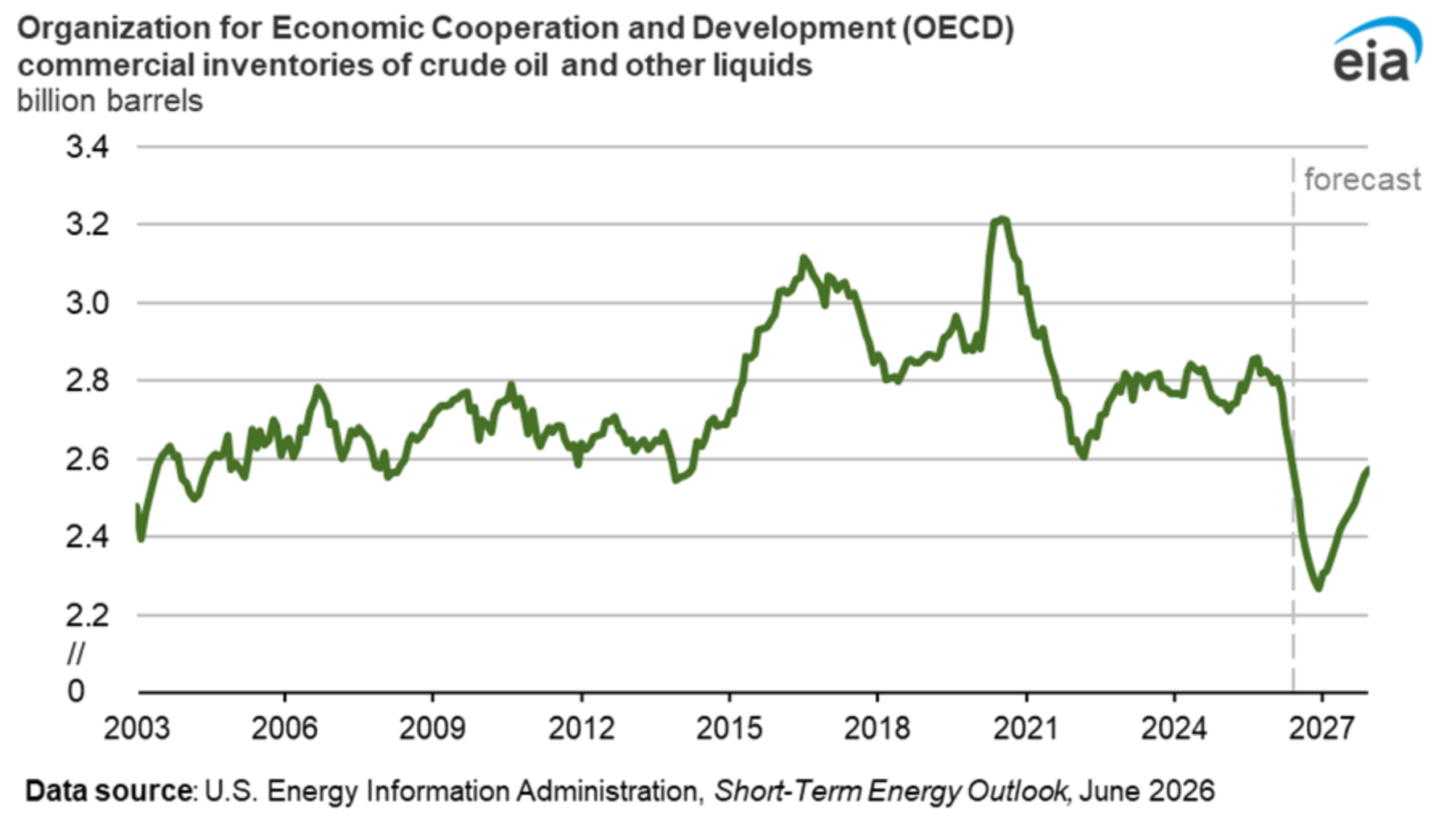
OECD commercial oil inventories in days of demand cover fall to about 50 days by the end of 2026, the fewest since January 2003, even as Brent round trips to its pre-war price. The screen has erased the war premium while the physical cushion has not been rebuilt (EIA Short Term Energy Outlook, June 2026; IEA Oil Market Report, 17 June 2026).
Cheaper fuel has reached European pumps because the world bought less oil, not because the tank refilled, and an empty tank is a coiled spring.
Geopolitics
Cheap Brent Did to Moscow's Budget What Four Years of Sanctions Could Not.
Urals near $60. A first quarter deficit already larger than the whole year plan.
As Brent fell to $72, Urals, the discounted grade Russia actually sells, slid into the low $60s, down roughly a third in a month. The price collapse landed on a budget already breaking: Russia ran a federal deficit of 4.6 trillion rubles in the first quarter of 2026, larger than the gap planned for the entire year, as oil and gas revenue fell 45%. Ukraine compounded the squeeze on the physical side, striking the Kapotnya refinery on the edge of Moscow on 16 and 18 June in the largest drone assault on the capital of the war, damage that may keep the plant offline for the rest of the year, with more than 20% of Russia's total refining capacity now knocked out and export bans on gasoline since 1 April and jet fuel since 1 June. For Central and Eastern Europe this is the double squeeze that no sanctions package delivered, a producer that cannot refine its own fuel now also selling its crude near $60. The trap is the same one Crude has flagged since the price began falling: the cheaper the oil that punishes Moscow, the weaker the economic case for the costly break from Russian supply, and Austria and Germany, carrying the deepest exposure, feel that pull first.
In Focus · Loadings
The Gulf Is Coming Back Faster Than Anyone Modeled.
Two million barrels a day returned in three weeks. They are refilling tanks, not flooding the market.
The number the relief coverage underplayed is the speed of the Gulf restart. Shut-in production across the Gulf fell to about 9.6 million barrels per day by mid June, down from 11.7 million just three weeks earlier, roughly 2 million barrels per day back online in twenty one days, with a full regional recovery now expected by year end. Saudi Aramco reloaded its Ras Tanura terminal on 26 June with two very large crude carriers, the supertankers that each move about 2 million barrels, its first loading since 8 March. This is a sharp reversal of Kuwait's earlier guidance that Gulf output would not recover quickly, which Crude flagged in early June. The deeper point for the price is where these barrels go. They are landing into the thinnest inventories in 23 years, so the first job of returning Gulf crude is to rebuild depleted stocks, not to crash the screen. That is precisely why the IEA pushes the real surplus into 2027: the recovery is fast, but the hole it fills is deep, and a market that has to refill before it can flood is a market with a floor under it.
Take Action
Five Signals to Watch This Week
Concrete checkpoints between now and the next issue.
- Read the inventory data, not the price. Track the OECD days of cover figure in the EIA outlook at eia.gov and the IEA Oil Market Report at iea.org, about 50 days and the lowest since 2003; a deeper draw is bullish for oil even as Gulf supply returns, because the cushion is still emptying.
- Set Brent alerts at $70 and $78. A clean hold above $70 confirms the floor this issue argues for, while a decisive break below it signals the glut is arriving faster than the IEA's 2027 timeline.
- Watch the Hormuz crossings and Gulf loadings. Follow the count on Lloyd's List or Kpler; the climb from 75% of prewar toward full recovery is the bearish completion, while any stall while inventories stay thin is the bullish surprise.
- Track Russia's Urals price and budget math. Urals near $60 and a 4.6 trillion ruble first quarter deficit are the real measure of the squeeze; the open question for Europe is whether it holds once the emergency fades and cheap oil tempts buyers back toward Russian supply.
- Check your restocking exposure. If you hold European refiners or utilities, a 23 year inventory low plus a fragile US Iran deal is the setup for a price floor and a winter risk premium, not a one way slide, so reread the hedging disclosures you discounted when oil was at $109.