
Issue 8 · July 6, 2026
Brent Sat at $72 for a Second Week. The Price That Moved Was Gas.
Brent oil sat at 72 dollars for a second straight week, its fourth weekly loss, with Saudi exports back to 90 percent of pre-war levels and OPEC agreeing to pump even more in August. In the same week, European gas jumped about 12 percent to a three-week high.
This Week · The oil floor holds · Europe's winter gas gap · Ukraine widens the refinery war
Lead Story
Brent Sat at $72 for a Second Week. The Price That Moved Was Gas.
A heatwave is burning the gas Europe needs for winter, and storage is running a deficit no one is pricing.
Brent crude, the global oil price benchmark, settled at $72.05 per barrel on Friday 3 July 2026, essentially flat on the week and its fourth straight weekly loss, even as Saudi Arabian exports climbed back to about 90 percent of their pre-war level and OPEC+, the group of major oil producers that jointly sets output, agreed another supply increase for August. The floor at $72 that Crude called last week held for a second week. The price that actually moved was European gas. TTF, the benchmark wholesale natural gas price for Europe, settled near EUR 45.4 per megawatt hour, a three week high, up about 12 percent on the week, as a heatwave across the continent pushed power stations to burn more gas for air conditioning. European storage sits at about 48 percent full, against 56 percent a year ago and a five year seasonal average of 61 percent.
The mechanics are simple and the consequence is not priced. Every megawatt the heatwave pulls from a gas plant to run air conditioning is gas that does not go into storage for winter, and the injection season is already half gone. The summer that is delivering cheap petrol at the pump, with Brent down from $109 in mid May, is quietly building an expensive winter at the meter. For the next 30 to 90 days the risk for a European household is not oil, it is gas. Watch storage fill and TTF through August, because a cold start to the heating season on 48 percent storage is the setup for a price spike that lands on heating bills in the fourth quarter, and the calm in the oil market is the thing hiding it.
Chart · EU Gas Storage Versus the Five Year Range
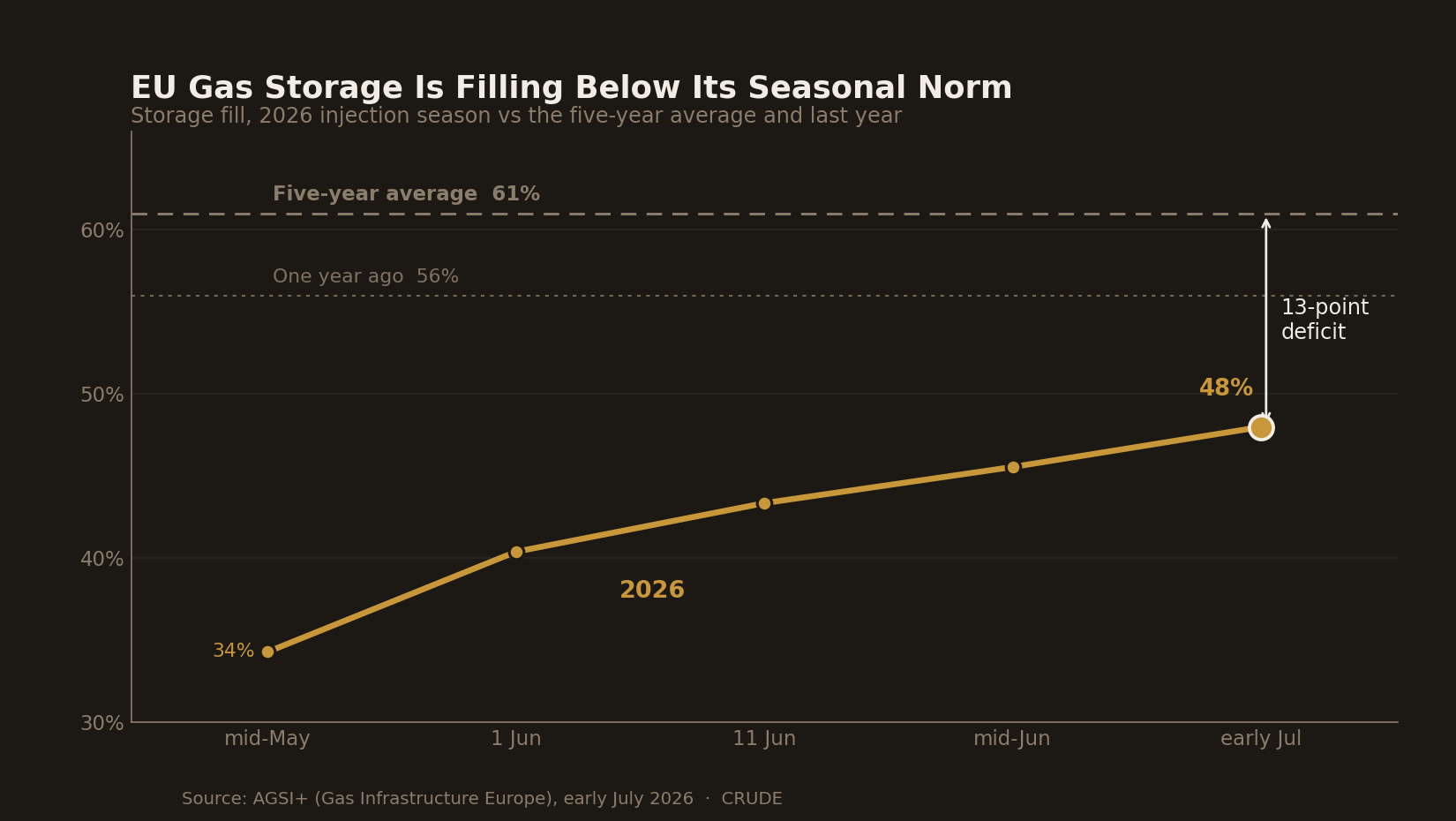
EU gas storage fill versus the five year seasonal range. Storage entered July 2026 near 48 percent, tracking below both last year's 56 percent and the five year average of 61 percent, because heatwave driven power demand is diverting gas from injection. The oil glut dominated the headlines while the gas cushion for winter quietly failed to rebuild (Aggregated Gas Storage Inventory, AGSI+, early July 2026).
The summer that is delivering cheap petrol at the pump is quietly building an expensive winter at the meter.
Geopolitics
Ukraine Is Winning the Refinery War. Cheap Oil Is Losing Europe the Argument.
Kyiv has now hit nearly every refinery in European Russia. The barrels OPEC keeps adding make Moscow's crude cheaper still.
Ukraine struck the Ufa oil refinery, one of Russia's largest, for the second time in a week on 1 July 2026, and by the end of May not a single major refinery in European Russia had escaped a drone attack. Russian refined output has fallen by roughly 700,000 barrels a day, about 13 percent, from 5.2 million in March, and Urals, the discounted grade Russia actually sells, sits in the low $60s. OPEC+ deepened the squeeze from the other side, with seven core members including Russia agreeing on 5 July to add another 188,000 barrels a day in August, pressure that pushes global crude and Urals with it lower. That is a war economy breaking, the double squeeze four years of sanctions never delivered. The trap for Central and Eastern Europe is the one Crude has flagged since the price began to fall, and this week it sharpens: if thin storage meets a cold winter and gas spikes, the political pressure to quietly restore cheap Russian molecules comes straight back, and Austria and Germany, carrying the deepest exposure, feel that pull first.
In Focus · Storage
The 61 Percent the Oil Glut Buried
The storage number that will set European bills, not the barrel count that set the headlines.
The figure the glut coverage ignored is a storage reading. European gas storage stood at about 48 percent of capacity in early July 2026, against a five year seasonal average of 61 percent, a gap of 13 points with the summer injection season already half spent. The cause is the heatwave, which drove most European power markets above EUR 115 per megawatt hour in late June and pulled gas into electricity generation rather than into the ground. Equinor, Norway's state gas supplier, has already warned that even the 80 percent target is out of reach this year. A Bloomberg terminal reader saw the oil glut in every screen. The number that will actually decide what Europeans pay to heat their homes is the one quietly failing to fill, and it points the other way.
Take Action
Five Signals to Watch This Week
Concrete checkpoints between now and the next issue.
- Read the AGSI+ storage dashboard at agsi.gie.eu. Watch weekly EU fill against the five year band; a gap widening below 61 percent is the winter risk this issue flags before the market prices it.
- Set TTF alerts at EUR 40 and EUR 50. A hold above EUR 45 through July confirms the heatwave has flipped gas from soft to tight, and EUR 50 is the level where winter supply fear starts entering the price.
- Track Brent at $70 and $65. The $72 floor held a second week; a break below $65 says Citi's $60 target and OPEC's extra barrels are winning, while a clean hold confirms the floor Crude has called.
- Follow the OPEC+ September meeting. The seven core members are one hike from fully unwinding their 2023 cut, and more barrels into a $72 market is the steady downward pressure on the floor.
- Check your gas and utility exposure. If you hold European utilities or pay a variable heating tariff, thin storage plus a cold winter is a fourth quarter price risk, not summer relief, so review your fixed versus variable options while gas is still cheap.