
Issue 03 · June 1, 2026
The Market Priced a Deal. Trump Did Not Sign It.
Brent at $92 prices the best case. The best case has not happened.
This Week · Brent at $92, deal unsigned · Europe misses gas storage target · Diesel draw doubles the forecast
Lead Story
The Market Priced a Deal. Trump Did Not Sign It.
Brent at $92 prices the best case. The best case has not happened.
Brent crude (the global oil price benchmark, denominated in US dollars per barrel) settled at approximately $92.05 per barrel on the Friday 29 May 2026 close, down approximately 11% on the week from $103.94 and roughly 19% over the month of May, the steepest monthly decline since March 2020 when global lockdowns collapsed oil demand in weeks. TTF (Europe's benchmark wholesale natural gas price, traded on the Title Transfer Facility exchange in the Netherlands) settled at €45.96 per megawatt-hour on the same date, down approximately 5.6% on the week. The driver of both moves was a single diplomatic development: on 28 May, US and Iranian negotiating teams agreed in principle on a 60-day memorandum of understanding to extend the ceasefire and begin nuclear talks, with a provision requiring Iran to remove naval mines from the Strait of Hormuz (the waterway between Iran and Oman through which approximately one-fifth of global oil supply passes every day) within 30 days of any signature. The word "signature" is load-bearing. Trump left a White House Situation Room meeting on Friday 29 May without announcing whether he would approve the agreement, while Defense Secretary Pete Hegseth confirmed publicly that American forces stood ready to resume combat operations in the Gulf if talks collapsed. The week was not a straight line: US forces launched self-defense strikes on southern Iranian military sites on 26 May, driving Brent briefly back to $100 per barrel before ceasefire optimism reasserted itself through Thursday's session and into the Friday settlement.
For a European retail investor, the risk at $92 is not symmetric. If Trump approves the MOU and Hormuz reopens, the EIA (the US Energy Information Administration, which publishes monthly global energy forecasts) projects Brent at $89 per barrel in the fourth quarter of 2026 as Gulf supply gradually returns to the market. A move from $92 to $89 is 3%. If the deal fails because Trump's conditions on nuclear disarmament or unfrozen Iranian assets prove unacceptable in Tehran, or because the next exchange of US and Iranian strikes fractures diplomatic momentum, Brent snaps back toward $103. That is an 11% move. The remaining downside is roughly 3%. The potential loss if you are on the wrong side is more than three times that. The structural picture does not support the bullish case either: the United Arab Emirates formally exited OPEC+ (the group of major oil-producing countries that jointly manages output levels to influence prices) on 1 May 2026, freeing itself from a production quota of 3.2 million barrels per day to pursue a stated capacity target of 5 million barrels per day by 2027. OPEC+ authorised a collective output increase of just 188,000 barrels per day in its first meeting without the UAE on 3 May. When Hormuz reopens and Iranian and unconstrained UAE supply return to a market where demand has already contracted, oil faces sustained downward pressure through the second half of 2026 regardless of which diplomatic script the next fortnight follows. At $92, you are paying for the optimistic version of a scenario that has not been delivered.
Chart · Brent 30-day price history
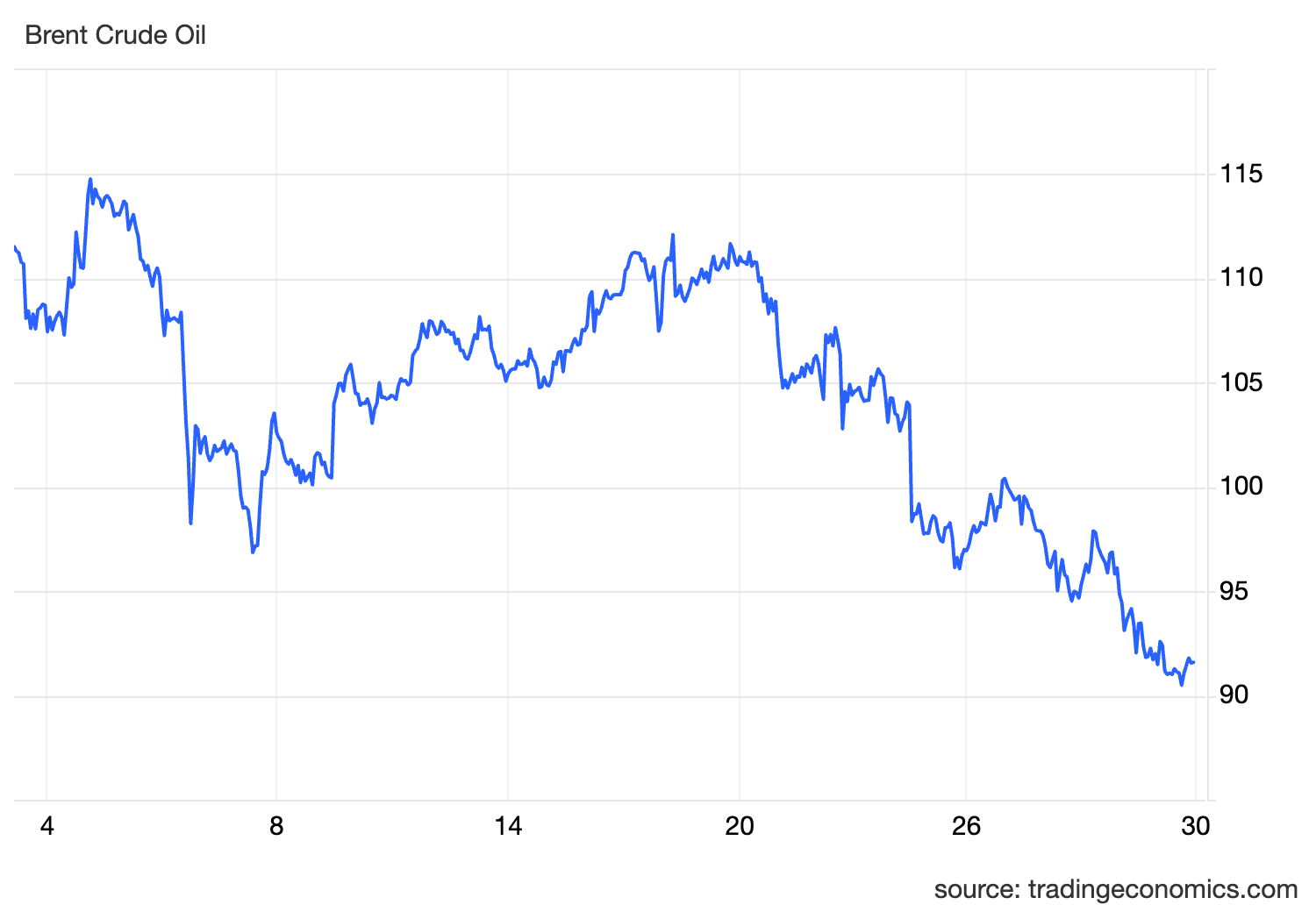
Brent crude's May 2026 price history shows a month defined by diplomatic signals rather than supply data. The month opened near $112 and briefly spiked to $115 in the first week before falling sharply, then recovered to around $110 before Trump's ceasefire signal on 18 May began the sustained decline. The brief reversal to $100 on 26 May reflects the same-day US strikes on Iranian territory. Friday's settlement near $92 prices a deal that was not signed. The chart also clarifies the 19% monthly decline: from the May 5 peak at $115 to the May 29 close near $91 is a fall of approximately $24 per barrel.
At $92, you are paying for the optimistic version of a scenario that has not been delivered.
Geopolitics
Europe Cannot Fill Its Gas Stores. Winter Is Thirteen Weeks Away.
Equinor confirmed this week that the 80% storage target is unreachable. On Equinor's own numbers, three more months of Hormuz disruption nearly doubles European wholesale gas costs from Friday's level.
While the Iran negotiations dominated oil market coverage this week, the number with the most direct consequence for European households and investors arrived in a different part of the energy market. European natural gas storage (underground reserves held across the continent in depleted gas fields and salt caverns, designed to buffer against winter demand peaks and supply shortfalls) stood at between 35% and 37% of total capacity in the final week of May 2026, against a norm of approximately 50% for this point in the injection season, a deficit of 13 to 15 percentage points. On 29 May, executives at Equinor (the Norwegian state energy company and one of Europe's largest gas suppliers to the continent) confirmed publicly that Europe will not reach the EU-mandated 80% winter storage target before the October injection season ends, a threshold that was already reduced from 90% specifically because of the current supply crisis. Equinor's scenario analysis is specific about the price consequence: a one-to-three-month Hormuz disruption pushes TTF to €90 per megawatt-hour, a 96% increase from Friday's close of €45.96. A near-doubling of wholesale gas costs flows directly into household electricity bills, industrial heating, and energy-intensive manufacturing across Europe. The countries carrying the steepest storage deficits and the greatest structural exposure are Germany, Austria, and the Netherlands, each of which has relied on liquefied natural gas imports to compensate for reduced Russian pipeline supply and now faces a storage shortfall that Norwegian pipeline volumes alone cannot close. For a European retail investor with exposure to utilities, chemicals, or heavy industry, the gas storage trajectory is a more material risk than the Brent price over the next quarter, and it is not priced into those sectors at current TTF levels. The Iran deal, if signed, buys time on this trajectory. If it is not signed by the time the market opens Monday, the trajectory from €46 toward €90 accelerates.
In Focus · Distillates
The Diesel Draw the Demand Story Cannot Explain
American refiners at near-maximum output still generated a draw twice the analyst forecast. European buyers will not feel the oil price decline at the pump.
The EIA weekly petroleum status report published on 28 May 2026, covering the week ending 22 May, recorded a fall in distillate fuel inventories (the category covering diesel, heating oil, and jet fuel, which together power European road freight, rail networks, and industrial and domestic heating) of 2.107 million barrels in a single week, more than twice the analyst consensus expectation of approximately 1 million barrels. Distillate stocks now sit roughly 11% below their five-year seasonal average, a structural shortfall that predates the Hormuz closure and signals that underlying diesel demand in the United States was already running ahead of supply before the current geopolitical disruption added pressure. For context: US refiners were operating at 94.5% of their maximum operable processing capacity (the proportion of total American refining capability actively in use) for the week ending 22 May, up from 91.6% the prior week, meaning American facilities ran near the physical ceiling of their output and the draw still came in at more than double expectations. For European buyers of diesel and heating oil, the implication is direct: with US refiners absorbing virtually all domestic production at near-maximum utilization, no American surplus is available to offset the supply shortfall that European refiners are already experiencing because of restricted crude feedstock from the Middle East. European diesel and heating oil costs face upward price pressure that is independent of whatever the Brent headline does. Even if the Iran deal is signed this week and Brent drifts toward $89 by August, European fleet operators, logistics companies, and heating oil buyers will not feel a proportional 3% cost reduction. The gap between the oil price signal and the distillate supply reality is where European consumers and businesses will feel the squeeze.
Take Action
Five Variables to Watch Before Monday's Open
Concrete checkpoints between now and the next issue.
- Watch for the Iran MOU before Monday's open. Reuters Energy at reuters.com/business/energy and Bloomberg will carry any overnight development. If Trump has signed the agreement, Brent's $89 EIA Q4 reference level becomes the near-term anchor. If talks have broken down, the risk to $103 returns immediately. This is the single variable that matters most before you read this issue.
- Set a TTF price alert at €60 per megawatt-hour. Equinor places €90 as the crisis level under a sustained Hormuz blockage, but the move from €45.96 to €90 passes through €60 first. A break above €60 signals that the market has begun pricing the storage deficit Equinor flagged this week. You can set a free alert at tradingeconomics.com/commodity/eu-natural-gas or through most European brokerage platforms.
- Monitor European gas storage daily on the AGSI+ tracker. Gas Infrastructure Europe publishes daily fill rates by country at agsi.gie.eu. Germany, Austria, and the Netherlands carry the largest gaps versus seasonal norms. Note each week whether the injection rate is closing the gap to the 50% seasonal norm or widening it further.
- Mark 17 June 2026 in your calendar. That is the scheduled publication date for the IEA June Oil Market Report, the first IEA report to capture the full demand impact of the Hormuz closure. If the IEA revises its demand contraction estimate materially above what it published in May, that is a price-negative signal for oil-linked positions regardless of any ceasefire agreement.
- If you hold European energy-intensive shares, check the hedging disclosures. A wholesale gas move from €46 toward €90 represents a near-doubling of unhedged gas input costs for sectors including chemicals, steel, and ceramics. BASF, Salzgitter, and Wienerberger each publish their hedging positions in quarterly results. The risk is not reflected in equity valuations at current TTF levels.