
Issue 04 · June 8, 2026
The Strait Is Shut. Beijing Is Why Oil Still Cannot Break $100.
Europe's energy bill is now hostage to Chinese demand, not Gulf supply.
This Week · Brent stuck below $100 · China crude imports collapse · Iran ends Hormuz talks
Lead Story
The Strait Is Shut. Beijing Is Why Oil Still Cannot Break $100.
Europe's energy bill is now hostage to Chinese demand, not Gulf supply.
Brent crude, the global oil price benchmark priced in US dollars per barrel, settled at $94.66 at the Friday 5 June close, up roughly 3% on the week. TTF, Europe's benchmark wholesale natural gas price, traded on the Title Transfer Facility hub in the Netherlands and quoted in euros per megawatt hour, settled near €48.50, higher on the week. The Strait of Hormuz, the narrow waterway between Iran and Oman through which close to one fifth of the world's oil passes every day, has been largely shut since late February. With the single most important chokepoint in the oil market closed, Brent above $100 should be the floor. Instead it is the ceiling, and that holds your fuel and heating bill lower than the blockade alone would suggest. The reason sits in Beijing. Chinese crude imports fell 20% year on year to 38.47 million tonnes in April, the lowest since July 2022, a drop large enough to offset a closed strait, and seaborne crude purchases fell by 3.6 million barrels per day between February and April.
For a European investor the lesson is uncomfortable: the thing capping the oil price right now is not comfortable supply, it is the collapse of demand in the world's largest buyer. OPEC+, the group of major oil producing countries that coordinates output to influence prices, authorised another 188,000 barrels per day of increases for July at its 7 June meeting, a fourth consecutive monthly rise. With the strait shut, those are phantom barrels: paper increases that cannot physically sail to market. Even the baseline numbers flatter the group, because OPEC+ quotas cover only crude and exclude condensates and natural gas liquids, the lighter petroleum liquids that count as oil supply but sit outside the quota, a loophole Bloomberg's Javier Blas called artistic deception. So supply is not the cap. Chinese demand is, and a demand cap is removable. The moment Chinese buying recovers with Hormuz still closed, nothing holds Brent under $100 and TTF follows it higher. Treat Brent near $94.66 and TTF near €48.50 as artificially low, propped down by a Chinese slump that can reverse faster than the strait can reopen. Over the next 30 to 90 days, watch Chinese monthly customs data, not the Gulf headlines. That is where the next move in your fuel and heating bill starts.
Chart · China monthly crude imports
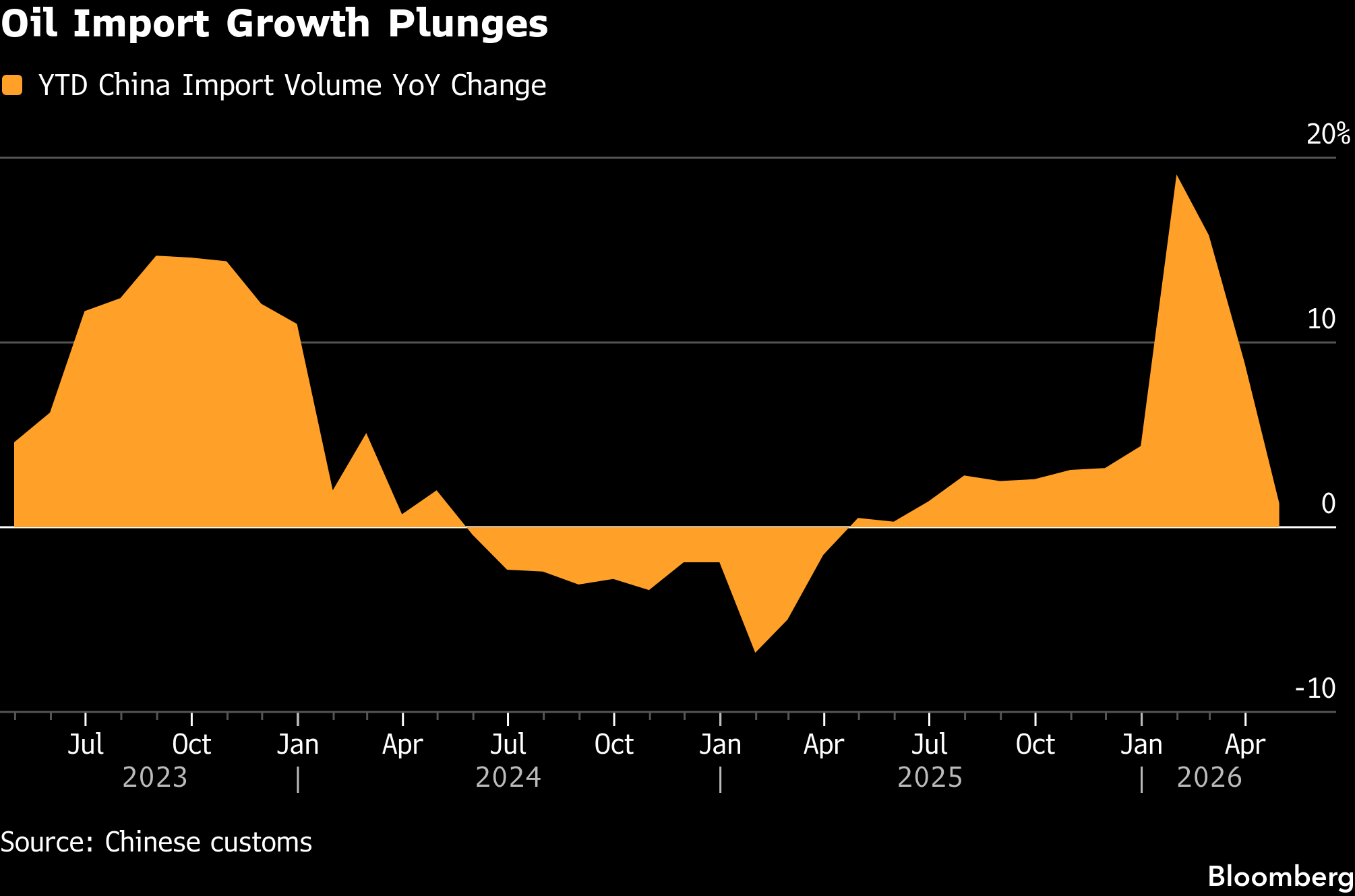
China's year to date oil import growth, measured year on year, fell from almost 20% at the start of 2026 to roughly zero by April (Chinese customs, via Bloomberg, 11 May 2026). The buyer whose appetite has driven the global oil market for two decades has stopped growing. That stall, not Gulf supply, is what is holding Brent below $100. When this line turns back up with Hormuz still shut, the price cap comes off.
The moment Chinese buying recovers with Hormuz still closed, nothing holds Brent under $100 and TTF follows it higher.
Geopolitics
Tehran Just Killed the Deal Europe Was Counting On.
Iran walked out of talks and vowed to seal Hormuz completely. The reopening that markets were pricing is gone.
On 1 June, Iran formally ended indirect negotiations with the United States and vowed to completely block the Strait of Hormuz, while threatening to extend disruption to the Bab al-Mandeb strait at the southern end of the Red Sea, citing ceasefire violations tied to Israeli operations in Lebanon. Brent rose 6.7% to $97.28 within hours of the announcement. The European consequence is direct. Last week's market still priced a path to the strait reopening this summer. That path is now closed, and Gulf producers including Kuwait have signalled that output will not recover quickly even after Hormuz reopens, which pushes any real relief on European supply into the fourth quarter at the earliest. For Central and Eastern Europe the squeeze compounds. Countries that replaced Russian pipeline crude and gas with seaborne and liquefied natural gas cargoes routed past the Gulf now face both a closed strait and a shrinking Russian backstop, as Moscow concedes its oil output is falling under Ukrainian drone strikes on its refineries. The practical result over the next quarter: no structural relief on European crude or gas input costs, and a widening gap between the Brent screen price and what European refiners actually pay for a delivered barrel.
In Focus · Flows
The Cleanest Number on the Blockade: Iraq to China, Down 92%.
One trade route shows exactly how completely Hormuz has closed.
China's imports of Iraqi crude collapsed to about 60,000 barrels per day in May, from 790,000 in February, a fall of roughly 92%. Iraq routes close to 95% of its oil exports through Hormuz because its southern Basra terminals sit inside the Gulf and its Turkey pipeline is largely offline, and its southern fields have cut output by about 70%, from 4.3 million to 1.3 million barrels per day, since the conflict began. This one corridor is the cleanest read on the blockade precisely because Iraq, unlike Saudi Arabia, has almost no pipeline route to the Red Sea to bypass the strait, so its export figure is a near pure measure of how shut Hormuz actually is. For a European investor the signal is that this disruption is physical and close to total, not a risk premium sitting on paper. As long as Iraqi barrels cannot reach Asia, the Middle Eastern crude that Europe and Asia compete for stays scarce, and the phantom OPEC+ increases change nothing. When this number starts to climb, it will be the earliest hard evidence that the strait is genuinely reopening, ahead of any official statement from Tehran or Washington.
Take Action
Five Signals to Watch This Week
Concrete checkpoints between now and the next issue.
- Track China's next monthly crude import release from the General Administration of Customs. It is the cleanest signal of whether the demand collapse capping Brent is easing. A rebound toward the volumes seen before the crisis, with Hormuz still shut, is the trigger for Brent to break $100 and for your fuel costs to rise with it.
- Watch the Iraq to China crude figure, currently near 60,000 barrels per day against 790,000 in February. A move back above roughly 200,000 would be early physical proof the strait is reopening, before any government confirms it.
- Read the OPEC+ 7 June communique yourself at opec.org. The reported 188,000 barrels per day July increase is confirmed and is the fourth consecutive monthly rise. Treat the headline barrel number as phantom while the strait stays closed.
- Set a Brent alert at $100 and a TTF alert at €55 per megawatt hour. Both prices are held down by Chinese weakness, not by easy supply, so a break above either level signals the cap has lifted. Free alerts at tradingeconomics.com.
- If you hold European refiners or airlines, check their crude sourcing and fuel hedging disclosures. The gap between Brent near $94.66 and the delivered cost of a Gulf barrel is widening, and names such as TotalEnergies, Shell, Lufthansa, and IAG, the International Airlines Group that owns British Airways and Iberia, carry direct exposure. American Airlines has already suspended summer routes over jet fuel costs.