Brent Paid for a Hormuz Deal That Only Tehran Has Announced
This week: Hormuz deal, one signer · Qatar force majeure · Two tankers in one week
Lead Story
Brent Paid for a Hormuz Deal That Only Tehran Has Announced
The Revolutionary Guard says the revenue split is agreed. Oman has not confirmed it, and has told the United Nations it will look at voluntary payments for navigation services, not tolls.
Two tankers were hit near the Strait of Hormuz this week. Brent settled at 89.31 dollars a barrel on Friday, against 94.39 a week earlier. It was already lower on Monday, when Washington rolled out its Iran sanctions plan. On Tuesday the Iranian and Omani foreign ministries published a joint statement describing an interim framework for resuming ship transits, and it mentioned no fees. On Wednesday the spokesman for Iran's Revolutionary Guard, Hossein Mohebbi, said the two countries had settled each state's share of the strait's waters and of its revenues, and that Washington was obstructing the process. No second party has confirmed that. In July Oman told the International Maritime Organization, the United Nations shipping agency, that it does not support transit fees on vessels, only voluntary payments for navigation services. The United Kingdom Maritime Trade Operations logged the tanker Metro Venetian disabled off Oman on Monday and the Kuwaiti tanker Al Salam II hit near Khasab on Tuesday. Transits through the strait rose by more than thirty percent in the week to 23 August 2026 and stayed below their pre war level.
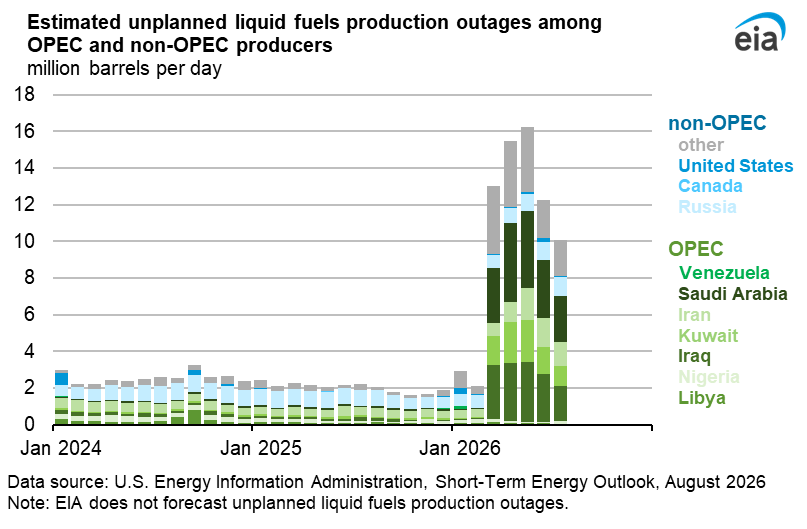
Estimated unplanned production outages among OPEC and non OPEC producers, in millions of barrels a day, from January 2024 to the latest month in the August outlook. The bars sit low and flat through 2024 and 2025, rise to their tallest in the spring of this year, and the most recent still stands well above every bar before February. The same outlook has most regional production back near pre war levels in early 2027 and a residue running to the end of that year. The series ends before the week described here, so it cannot show Friday's fall. It shows what the fall was priced against. Source: US Energy Information Administration, Short Term Energy Outlook, published 11 August 2026.
An agreement needs two signatures, and the announced one belongs to the government that closed the water. The missing one belongs to the government that would administer the corridor and has offered voluntary payments rather than the tolls a revenue share is made of. A voluntary payment is not a revenue to divide, and the statement both ministries did sign says nothing about money.
Four things competed for that five dollars and three have earned a share. Washington's sanctions plan told the market this is an economic confrontation, not an imminent threat to supply. The transit count went up, which is measured movement, not a forecast. And on Friday the new chairman of the United States Federal Reserve, Kevin Warsh, told Jackson Hole that rate rises are back in play, and a market expecting a stronger dollar takes money out of everything priced in dollars. The fourth input has nothing behind it. A transit regime existing as one belligerent's press statement is not a reopening, and Crude's position is that the talks produce no signed and accepted text before the end of September. A Hormuz agreement carrying both foreign ministries and a public acceptance from the United States Treasury or State Department, published before 30 September 2026, kills that call.
The oil price is not the price a European household pays. Dutch TTF, the wholesale gas price European tariffs are built on, settled at 66.47 euros a megawatt hour on Friday, 34.85 euros above the same week last year and more than double it. On a gas heated home in Germany, Austria or Italy burning fifteen megawatt hours a year, that gap is about 523 euros of wholesale cost, before tax, network charges or margin. The oil price is the news. The gas price is the bill.
Scorecard. Last week Crude called Brent to hold above ninety dollars a barrel on a window running to 8 October 2026. Friday's settlement was below it. MISS.
The record. Twenty four hits, thirteen misses and four partials on decided calls across the archive, with forty two still open.
Geopolitics
Qatar Is Negotiating One Strait and Planning Around Another
Its prime minister was in Tehran on Thursday. Its energy company spent Friday telling an Italian utility that gas contracted for this year will not arrive.
Iran's foreign minister, Abbas Araghchi, met Qatar's prime minister, Sheikh Mohammed bin Abdulrahman Al Thani, in Tehran on Thursday to discuss ending the war and reopening the strait. On Friday QatarEnergy told the Italian utility Edison it could not deliver five further cargoes of liquefied natural gas, extending a force majeure that now runs from early April to early November. That is twenty nine cargoes, about a hundred and thirty million cubic metres of regasified gas each and just under four billion in total, contracted and not delivered. A supplier discussing a reopening in one capital while cancelling into November in another has already told you which he is planning around. Force majeure is not a postponement. It is a transfer: the seller owes nothing, the contract is suspended rather than broken, and the buyer rebuys the volume at the price of the day. Edison says it can source alternatives and meet its commitments, which is true and is the mechanism, not the reassurance. Those replacements are bought at the same European price Austrian, Slovak and Hungarian utilities pay, so a contract failure in Milan reaches a bill in Bratislava unreported. Europe's winter is negotiated in rooms where no European government sits, and paid for through contracts European companies signed.
In Focus: Tankers
Two Ships Were Hit in the Week the Premium Left
The Metro Venetian disabled off Oman on Monday, the Al Salam II holed and briefly alight on Tuesday, and the price fell anyway.
The Metro Venetian was struck by a projectile off Oman on Monday and disabled. On Tuesday the Al Salam II was hit above the waterline near Khasab and caught fire, put out by its crew, with no injuries and no oil lost. Both strikes came before the revenue split was announced.
Strip the week back and there are three documents and one measurement. A joint statement mentioning no fees. A revenue split one government has announced and the other has not. A corridor Washington is accused of obstructing by the accuser itself. And a transit count up more than thirty percent, still short of pre war. The measurement is worth paying for. The documents are not, and the discount is priced on all four.
A reader who wants to know whether the strait is reopening should count hulls, not dollars. That number is published weekly. The regime meant to make it permanent is not.
Take Action
If you pay a European energy bill
- Ask your gas supplier what share of your tariff moves with the wholesale price, and when your fixed period ends. In Germany, Austria or Italy that share decides how much of this year's increase you carry, and at full pass through a fifteen megawatt hour home carries 523 euros of it.
- Price your winter off the gas market, not the oil headline. Gas at more than double last year's level is the number that reaches your bill, and on that home every euro per megawatt hour you fix above today's level costs you 15 euros a year.
If you follow the market
- Compare the announcements, not the prices. Until a Hormuz text carries both foreign ministries and Washington has said what it will do, the strait has not been reopened, it has been described.
- Time the 6 September 2026 meeting of OPEC+, the group that sets output quotas, against the outage chart above. Its September quota completes the rollback of the voluntary cuts, though an older layer stays in place, so the October decision is the first clean read on whether it thinks the barrels are coming back.
- Put a date on Qatar. If November arrives with the force majeure in place, the corridor talks have not moved a molecule of gas, whatever was signed.
Standing watch: the European gas storage dashboard at agsi.gie.eu.
Follow Crude so the next one finds you.
Follow Crude on LinkedIn