
Iraq Discounted Its Way Out of the Gulf by Twenty Five Dollars a Barrel
This week: Baghdad's oil discount · Tanker for tanker · Hormuz below the Cape
Lead Story
Iraq Discounted Its Way Out of the Gulf by Twenty Five Dollars a Barrel
OPEC+ held its October quotas steady on Sunday after six straight monthly increases. Quotas are not what cleared Iraq's barrels.
Iraq shipped more oil in August than in any month since the war began. On Saturday the American military said it had disabled two Iranian oil tankers and destroyed a third. Two Iraqi energy officials put August exports near two and a third million barrels a day, and two independent trackers a little lower, at two and a fifth and two and three tenths. The same officials put July at about one and a third million, with independent estimates either side, so the jump is large and unsettled in size. Both put February, before the war, between three and a third and three and seven tenths million, leaving August more than a third below their own pre war reading. Iraq's state marketer was offering August cargoes of Basrah crude at twenty five to thirty dollars a barrel below its own official selling prices, free on board. Iranian state media reported in late August that Tehran had granted Iraqi tankers permission to cross, which Iraq's president confirmed.
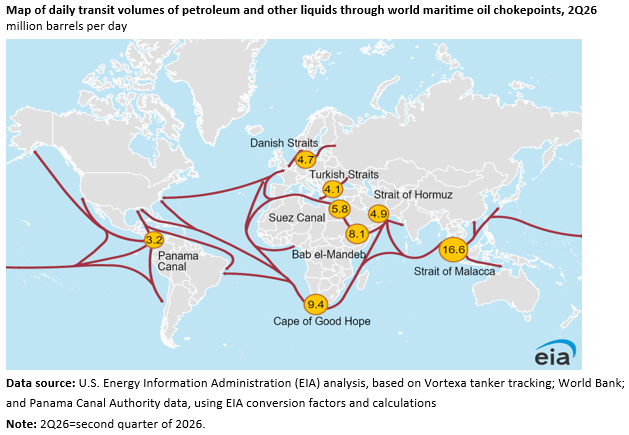
Daily transit volumes of oil and other liquids through the world's maritime chokepoints, in millions of barrels a day, averaged over the second quarter. It ends before the week described here. What it shows is the ranking that week was measured against: more than sixteen million barrels a day through Malacca, more than nine round the Cape, under five through Hormuz. Source: United States Energy Information Administration, Short Term Energy Outlook, 11 August 2026.
Brent crude, the grade most internationally traded oil is priced against, settled at 96.28 dollars a barrel on Friday, its strongest week since July on the continuous front month series. The previous Friday's 89.31 was the expiring October contract, so the two prints are different delivery months. Dutch TTF, the wholesale gas price European household tariffs are built from, settled at 71.96 euros a megawatt hour and more than double the same week a year ago.
The recovery was not granted by a strait. It was bought at a terminal. On Sunday the seven OPEC+ countries that set the voluntary output adjustments between them, Iraq among them, held October targets unchanged after six consecutive monthly increases. A quota governs how much a member produces, and what constrained Iraq in August was getting the oil out. What moved it was a discount deep enough to pay a buyer for loading inside a war zone, plus a permission from the government prosecuting the war. The honest rival reading is that Brent rose only because American and Iranian strikes resumed after a month of quiet, making it a risk premium. The two readings separate on one print. If the discount narrows, the strait is genuinely opening. If it stays wide, Baghdad is renting access rather than regaining it. Crude takes the second. A reported Basrah offer for October or November loading at a discount narrower than twenty dollars to its official selling price, published by 30 November 2026, kills that call.
There are one hundred and fifty nine litres in a barrel of oil. Friday's 96.28 dollars, converted at Friday's 1.1610 dollars to the euro, is about fifty two euro cents of crude in every litre, before tax, refining and the retailer's margin. Brent is up about forty seven percent on the year, so on the same conversion that litre carried about thirty five cents a year ago. Seventeen euro cents a litre is how far the year has reached into a European tank.
Geopolitics
Washington Is Now Sinking the Cargo It Also Escorts
Central Command counted a record escort day this week and destroyed Iranian tankers in the same water.
United States Central Command said it permanently disabled two Iranian oil tankers on Saturday, the Downy off Kharg Island and a second off Jask, and destroyed the Kylo in the Gulf of Oman. No independent party has verified the vessels' condition. An American official called the policy tanker for tanker, approved by the President and first used at the start of September. It followed missile fire from Iran's Revolutionary Guard at American warships, which the command said two ships evaded. Admiral Brad Cooper, who commands it, put the exchange rate in public: shoot at two of our ships, he said, and we impose a higher economic cost by taking out three of yours. Tehran then claimed three oil tankers and three vessels it called American linked, which nobody independent has confirmed either. Read what changed, not who is winning. Since May this headquarters has published the barrels it escorts through this water. On the first of September it counted, on its own tally, a record day of about eighteen million barrels across as many as forty hulls. Ship trackers counted eleven vessels through the strait that day, and analysts suspect the American number includes naval auxiliaries and support craft. It logged that record in the same week it began publishing the tankers it destroys. Both counts come out of the same building and only one adds a barrel. An escalation ladder whose rungs are oil tankers has no step on which the price of oil goes down.
In Focus: Chokepoints
Hormuz Moved Less Oil Last Quarter Than the Long Way Round Africa
The American energy agency's own second quarter map has the strait this war is fought over in fifth place.
Through the second quarter the Strait of Hormuz carried under five million barrels a day of oil and other liquids, on United States Energy Information Administration numbers. The Cape of Good Hope, not a chokepoint but the detour that avoids one, carried more than nine. Bab el Mandeb and Suez both carried more, and Malacca more than sixteen million. The Danish Straits, the Baltic exit Russian crude uses, carried very nearly as much. In the first half of last year Hormuz moved close to twenty one million and only Malacca moved more.
The oil did not stop, it went the long way, and Iraq is building its own. Baghdad and Ankara signed a one year transit agreement on the first of August covering three quarters of a million barrels a day through the Kirkuk to Ceyhan pipeline, a contracted level, not a measured flow, on a line lately running under two hundred thousand into a Mediterranean port. Its marketer has also offered Basrah crude for loading outside Hormuz, ship to ship off Oman.
Going round is not free. A pipeline tariff, a longer voyage and a war risk premium are all in the price of a barrel that takes it, and none is on the Brent screen.
Take Action
If you pay a European energy bill
- Convert the screen into your own tank before reacting. Seventeen euro cents a litre of extra crude cost over the year is about 8.5 euros on a fifty litre fill, before tax and margin.
- Budget off the crude price, not the gas headline, if you buy heating oil by the tank, and treat the barrel as the floor, since heating oil carries the diesel crack too. The year's move alone is about 510 euros on a three thousand litre delivery.
If you follow the market
- Divide every export recovery by the discount that produced it. Iraq's rebound and its Basrah discount were in the same wire, and the discount says whether the recovery holds.
- Rank the chokepoints again before assuming Hormuz is the whole story. On the agency's second quarter numbers it sat behind Malacca, the Cape, Bab el Mandeb and Suez.
- Name the next date OPEC+ can move. October is set, the seven meet again on the fourth of October, and November is the first month they can answer any of this.
Standing watch: the European gas storage dashboard at agsi.gie.eu.
Follow Crude so the next one finds you.
Follow Crude on LinkedIn