
The Talks That Could Return Seven Tenths of the Missing Diesel Were Called Off
This week: The record crack · Salalah called off · The smaller half
Lead Story
The Talks That Could Return Seven Tenths of the Missing Diesel Were Called Off
The talks that could return seven tenths of the barrels were called off on Sunday. The lobbying that got a president's voice was about three tenths.
Europe's diesel premium over crude passed a hundred dollars a barrel for the first time on record. Brent settled lower on Friday, at 104.61 dollars. The crack broke a hundred in the first week of September, and Friday's fall followed a report that Iran and the Gulf states would meet in Salalah about the Strait of Hormuz. Bahrain said on Saturday it would not attend. On Sunday Oman postponed the meeting in the interests of consensus, setting no new date. Also on Sunday, at his golf course in Ireland, the President of the United States asked Ukraine to stop striking Russian diesel refining: let him go after targets, he said, but not diesel fuel, because he is causing a shortage of diesel fuel. American retail diesel passed six dollars a gallon in nominal terms for the first time last Thursday.
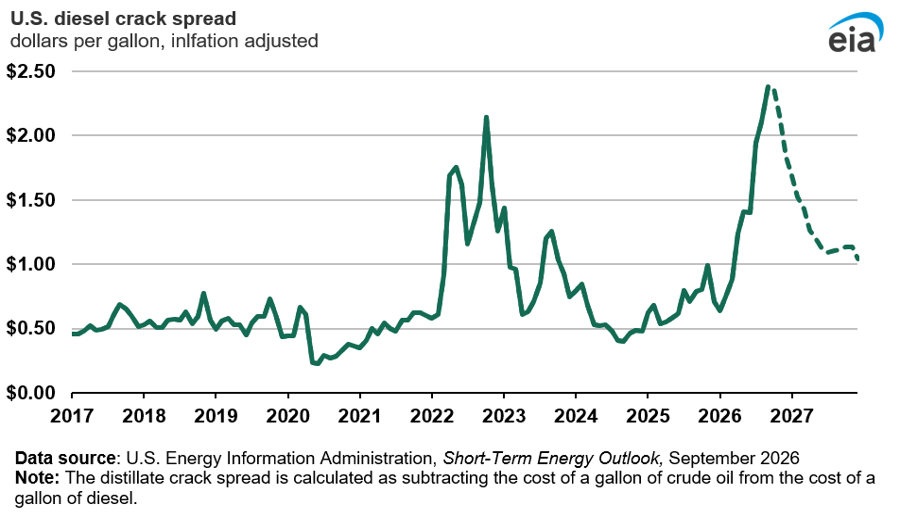
The American diesel crack spread, inflation adjusted dollars per gallon, 2017 to the end of 2027. Solid line history, dashed forecast. It is the United States series, not Europe's, and it stops before the week described here. Shown for the shape: near fifty cents a gallon to 2021, above two dollars late in 2022, higher again this year, that last peak sitting where history hands over to forecast. Source: United States Energy Information Administration, Short Term Energy Outlook, 9 September 2026.
Now do the division, because it sizes that request. The International Energy Agency reported on Friday that Gulf and Russian net exports of diesel and gasoil to world markets ran 1.6 million barrels a day below their February level in August, and that Gulf exports alone averaged 390 thousand barrels a day that month, a little over a quarter of what they were before the war. February is the pre war month here: the strikes on Iran began on the twenty eighth of it and the strait closed days later, so the two baselines are the same month. Work the Gulf back up from that quarter and its pre war level was near one and a half million, so the Gulf is missing about eleven hundred thousand barrels a day. Subtract that and Russia is missing about five hundred thousand, a little over three in ten. That quarter is a band rather than a number, so the honest range for the Russian share runs from about twenty seven to about forty percent, and the Gulf is the larger share on every reading in it.
So the barrels argued over on Sunday are the smaller share, and one Europe cannot lawfully buy: Russian diesel has been barred from the European Union since 2023, and since January so has diesel refined elsewhere from Russian crude. Friday is the test of which share the market answers to. A report that the Gulf states would sit down with Iran took nearly three percent off the barrel in one session, and two days later the meeting was off. The President gave his reason as harm to the world rather than to America, and the request may be sincere. It is simply aimed at the smaller share, and at barrels Europe cannot lawfully import, though a shortage anywhere raises the world price Europe pays through whichever cargo is marginal.
The bill itself: the European Commission's weekly survey put heating gas oil up 122.29 euros a thousand litres in the week to 7 September 2026, with road diesel up a little over half as much, both European averages with duty and tax included. A household ordering three thousand litres paid 366.87 euros more than it would have seven days earlier.
Crude's position is that the squeeze is structural rather than seasonal, so it survives the unwinding of the autumn maintenance season. The ICE low sulphur gasoil front month settles at a premium of more than eighty dollars a barrel to the ICE Brent front month on 30 November 2026, converting gasoil at seven point four five barrels to the tonne. A premium of eighty dollars or less on that settlement kills the call.
Geopolitics
Iran's Allies Took the Doorway, and Someone Shut the Corridor Behind It
The larger half of the missing diesel moved this week, and it moved in the Gulf.
Yemeni government military sources, a party to the war, place Iranian aligned Houthi forces in Mokha and the Hanish Islands on Thursday 10 September 2026, and on Perim Island in the middle of the Bab el-Mandeb on Friday 11 September 2026. Windward's maritime intelligence centre and several international outlets reported the same positions the same day. Windward's own conclusion is that traffic through the strait has not measurably changed since Mokha fell, though it counted outbound transits falling from twenty four to nine across two partial windows and warns that all its counts come from ship transponders and probably undercount. The strait is not closed. Its narrowest point is now held from the shore.
Then drones struck Saudi Arabia's east to west crude pipeline, and Riyadh announced on Friday 11 September 2026 that it had shut the line as a precaution. The Saudi foreign ministry said the drones came out of Iraq and that it would give Baghdad time to act; Baghdad placed the launch in Maysan province and dismissed a commander, and no group has claimed it. The pipeline moves four to five million barrels a day of crude west to Yanbu, and with Hormuz closed since March apart from brief reopenings in April and between June and July, it is not a convenience but the main road out. That is the larger half of the missing diesel, and it is the half with a negotiation attached. A chokepoint that has an owner is worth more to that owner closed on some days than open on all of them.
In Focus: Refining
The Things That Actually Set a European Diesel Bill This Autumn
None of them is in Kyiv. Two sit inside Europe, and the biggest is the strait.
The first is the Gulf, because a reopened strait is the only thing that returns seven tenths of the missing barrels at once, and Sunday postponed it. The second is European refinery maintenance: autumn turnarounds run through September and October, taking offline the hydrotreaters that make winter diesel while stocks are already thin. The third is independent gasoil stocks at Amsterdam, Rotterdam and Antwerp, near a four year low, with low water on the Rhine restricting the barges inland to Germany.
The fourth is India, whose refiners supplied about sixty percent of the diesel crossing the Bab el-Mandeb toward Europe in August, on a flow near two hundred thousand barrels a day. Behind all of it sits the European Union's own rule: the ban on products refined from Russian crude, in force since January, routes Europe's marginal barrel through Jamnagar rather than Primorsk.
Take Action
If you pay a European energy bill
- If you heat with oil, which in Europe mostly means Germany, Austria, Ireland, Belgium or France, order before the October maintenance peak rather than after. That week moved a three thousand litre order by 366.87 euros.
- Fix your heating oil price in writing rather than taking the spot quote on delivery day. The week to 7 September 2026 moved the European average by 12.2 cents a litre.
If you follow the market
- Count European turnarounds, not Russian refineries. Autumn maintenance unwinds in November, which is the month that tells you whether this squeeze was structural or seasonal.
- Track Indian diesel flows to Europe. They arrive through the Bab el-Mandeb and they are the marginal barrel at Rotterdam.
- Separate the Gulf share of the shortfall from the Russian share in everything you read. One is a closed strait whose negotiation just slipped; the other is about three tenths and cannot lawfully be sold into the European Union.
Standing watch: chokepoint transits on the International Monetary Fund's PortWatch portal, free and refreshed each Tuesday, and the Commission's oil bulletin, surveyed each Monday.
Follow Crude so the next one finds you.
Follow Crude on LinkedIn