
Is Europe's American Diesel Priced, or Just Untested?
This week: Washington's diesel · Russia's refineries · The storage gap
Lead Story
Is Europe's American Diesel Priced, or Just Untested?
Washington spent three days debating whether to keep its diesel at home, and the market where Europe buys diesel ended the week lower.
The United States has supplied about a third of the diesel the European Union imports this year. On Tuesday 22 September 2026 its president said, "let's not send out the diesel."
The ship tracking firm Kpler puts the American share of the diesel the European Union buys from outside its borders at about 32 percent so far this year, close to double last year's share, and at nearer three fifths in northwest Europe. On the same Tuesday the Treasury Secretary said officials were examining whether a full or partial ban on exports would work. On Wednesday the White House called a reported plan for a temporary ban "not true", and by Thursday the Energy Secretary was asking refiners to send a little less abroad voluntarily. By Friday nothing had been announced.
Over the same week the price of diesel in Europe's wholesale market went down. ICE low sulphur gasoil, the futures contract for diesel delivered into northwest Europe, settled at 1,460.75 dollars a tonne on Friday 25 September 2026 against 1,509.25 a week earlier, while Brent crude ended the week almost exactly where it started.
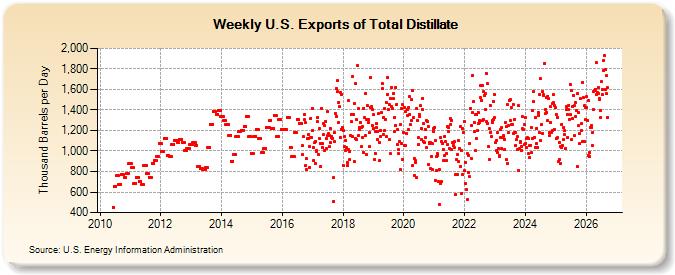
Weekly American exports of distillate, the family of fuels that includes diesel and heating oil, in thousand barrels a day from 2010 to the week ending 18 September 2026. The highest points in sixteen years all fall in 2026, which is the supply Europe has come to lean on; the last point shown is lower than the summer peak and predates the week's talk of a ban. Source: US Energy Information Administration, Weekly Petroleum Status Report.
That leaves a question worth settling before the heating season. Is Europe's dependence on American diesel already in the price, or has it simply never been tested?
The obvious answer is that traders heard the White House denial and moved on. The daily prices do not support it. Take the price of a barrel of crude away from the price of a barrel of diesel and what is left is diesel's premium over crude, the part of the price that belongs to the fuel rather than to the oil. That premium rose by about five dollars a barrel across Wednesday and Thursday, the two days the ban was most discussed, before falling back on Friday.
The second answer is that the talk did put a price on the risk, and that Iran's offer to reopen the Strait of Hormuz within seven days, reported on Friday, took it off again. That is harder to hold than it looks. The diesel futures price fell furthest on Monday, the day before the President first spoke of keeping diesel at home. Every day the ban was discussed also carried news from the Gulf of similar weight: a Saudi pipeline restarting, tankers failing to load at the Red Sea port of Yanbu, and an Iranian presidential speech that lifted crude by nearly four percent. A day's price cannot be divided between two governments speaking at once.
What the week does establish is the size of the exposure. If a ban came, the consultancy Wood Mackenzie estimates that the diesel crack spread in northwest Europe, what a refinery earns between the crude it buys and the diesel it sells, would rise by 27 percent. Its own headline finding is that Americans would pay more for petrol as well, and the President had already called the choice "a balance" two days before. The European Commission said plainly: "We believe this is a bad idea."
The pump, meanwhile, did not wait for Washington. The Commission's weekly survey put the average price of diesel in the European Union, taxes included, at a record 2,226.44 euros per 1,000 litres on 21 September 2026, against 2,158.74 a week earlier. That is 6.8 euro cents a litre more in a single week, which means about 4 euros on a 60 litre tank.
So the question stays open, and it has a date. The midterm elections on 3 November 2026 make the choice live in Washington, and a restriction announced before them would show within days whether Europe's price had been carrying the risk. The call: no formal American restriction on diesel exports, whether a ban, a quota, a licence requirement or a voluntary programme announced by the government with its participating refiners named, is announced before 3 November 2026. If one is, Europe's exposure stops being theoretical and the call is wrong.
Geopolitics
Russia Lost Three Refineries in Six Days and Europe Lost an Alternative
Europe buys no Russian diesel, and it still pays for every Russian refinery that stops.
Ukraine struck Russian refineries from Moscow to Perm in the week to Saturday 26 September 2026. Russian sources confirm what matters most. The Moscow refinery suspended operations on 21 September 2026, the Perm plant, the country's seventh largest, halted on 25 September 2026, and the governor of Rostov said the Novoshakhtinsk refinery stopped the same day. Kyiv's General Staff says more than 45 percent of Russian refining capacity is now disabled, a claim no independent tracker has confirmed.
Moscow's answer has been to keep its fuel at home. It is reported to be extending its ban on diesel exports by producers to the end of October, although no decree had been published by the weekend.
That reaches Europe by a longer road. Turkey, which used to buy much of its diesel from Russia, bought a record volume from India in August, according to Kpler. The same firm says Indian diesel shipments to Europe have fallen by about two thirds, because Indian refiners are finding better returns in East Africa and Southeast Asia. Every barrel Moscow keeps at home sends many of its former customers bidding against Europe for Indian diesel. For a European buyer that is the practical point: a supplier that could stand in for part of the American diesel already has better customers, and Russia's absence gives it more of them.
In Focus: Storage
Gas Fell Nine Percent in a Week With Storage Sixteen Points Short
The gas price answered a promise about the Gulf; the tanks answer only to what is pumped into them.
European gas storage was 70.6 percent full on 25 September 2026, according to Gas Infrastructure Europe, against a five year average for the date of 86.4 percent. In the seven days to that Friday the Dutch TTF contract, Europe's wholesale gas price, fell by more than nine percent.
Those two numbers answer to different things, because the price moves on expectations and this week the expectations improved: Qatar sent laden gas carriers out through Hormuz in the largest numbers in two months. Storage moves only on gas physically injected, and the injection season, when gas is pumped into storage for the winter, ends in early November. On Friday the European energy commissioner wrote to ministers that "we are facing a price crisis linking to a supply crisis" and asked them to consider cutting demand.
For anyone who heats with gas, that is the lesson worth keeping. A price that falls in September on news from the Gulf does nothing to the sixteen point gap in the tanks. That means the winter price will be set by how cold it gets rather than by what was said in New York.
Take Action
If you pay a European energy bill
- Wait until 1 October 2026 to fill a diesel tank in Germany, when the fuel tax cut of about 17 euro cents a litre begins. On a 60 litre tank that is about 10 euros.
- Book a heating oil delivery this week rather than waiting for Washington to decide. The Commission's heating oil price rose by about 4.06 euro cents a litre in the week to 21 September 2026, from 1,711.59 to 1,752.17 euros per 1,000 litres. If the next week repeats it, that is about 122 euros on a 3,000 litre tank.
If you follow the market
- Weigh northwest Europe separately from the European Union average. The region that sets the ICE gasoil price takes about three fifths of its imported diesel from America, against a third for the Union.
- Look for October cargo counts of American diesel to Europe from the ship trackers rather than the weekly US export total, which counts every destination and fell by almost a fifth in one week this month with no policy behind it.
- Note whether Moscow publishes its diesel export decree before the current ban lapses on 30 September 2026. A lapse would be the first sign that more Russian diesel can reach Turkey and leave more Indian cargoes for other buyers.
Standing watch: EU gas storage on Gas Infrastructure Europe's AGSI+ platform, free and updated daily.
Follow Crude so the next one finds you.
Follow Crude on LinkedIn