
Europe Was Told Zero for October and the Price of Oil Fell
This week: Zero for October · Riyadh's objection · What we cannot say
Lead Story
Europe Was Told Zero for October and the Price of Oil Fell
A Gulf supplier removed a month of Europe's contracted crude, and the price that normally registers such things went down.
Saudi Aramco has told its European refinery customers they will get no crude at all in October. It reached at least two of them on Friday, and three have had late September cargoes cancelled. The cut covers its term buyers, meaning the refineries that contract for a set volume every month rather than buying cargo by cargo. Brent settled at 103.87 dollars a barrel on Friday 18 September 2026, against 104.61 the Friday before, a fall of seven tenths of a percent.
The cause is not in doubt. Drones launched from Iraq struck Saudi Arabia's East to West crude pipeline on 10 September 2026, and the line has been shut since the day after. It carries crude from the Gulf coast to Yanbu on the Red Sea, the port European cargoes load from, so a shut pipeline closes Europe's door in particular.
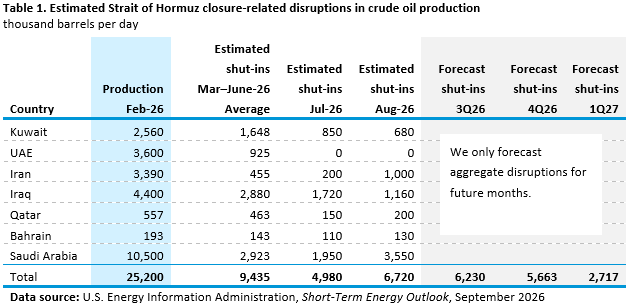
A table rather than a chart, and the clearest public account of what has left the Gulf. It estimates how much crude each Gulf producer has had to shut in, meaning oil it can pump but cannot currently sell, and attributes that to the closed Strait of Hormuz. Together they had close to seven million a day shut in during August. Source: US Energy Information Administration, Short Term Energy Outlook, 9 September 2026.
For anyone in Europe who pays an energy bill, the question is narrow. Is this an inconvenience that ends when a pipeline is welded, or a lasting change in what Europe pays for a barrel?
The obvious answer is that the barrels moved rather than disappeared. Saudi Arabia sold about sixty million barrels out of Ras Tanura, its terminal on the Gulf coast, for loading across September and October. They were passed between ships off the Omani coast, and Chinese and South Korean refiners were among the largest buyers. Reuters puts the week's calm in the futures market down to hopes of exactly that rebound.
But an eastern door opening does not explain a western one closing. Aramco's exports from inside the Gulf are running at about one to one and a half million barrels a day, similar to August. Nothing at all has loaded at Yanbu since 12 September 2026. The barrels that moved were never Europe's.
The second answer is that Europe is short of a particular kind of oil rather than a quantity of it, and that the shortage is structural. Refineries are built around a grade, and swapping one crude for another is neither quick nor free. Johan Sverdrup is Norway's flagship medium sour grade, heavier and higher in sulphur than light North Sea crude, which makes it the closest North Sea match for what Europe buys from the Gulf. On Tuesday 15 September 2026 the price reporting agency S&P Global Platts assessed it at 19.55 dollars a barrel above North Sea Dated, the benchmark that sets the price of North Sea grades.
That looks structural until you put it beside a number from the same week. On 10 September 2026, the day the pipeline was hit, BP sold a Sverdrup cargo to Equinor at a premium of 5.45 dollars. A shortage years in the making does not sit at five dollars on the morning of an event and at nineteen five days later.
What that premium is worth at the pump is smaller than it sounds. A barrel holds 159 litres, and at 1.1461 dollars to the euro the 19.55 dollar premium works out at 10.7 euro cents on the crude in every litre, before refining, shipping or tax. Treat it as an upper bound rather than a bill, because it assumes every cent reaches the customer, which it will not.
That leaves the repair timetable, and it is the thing a reader can check least. Aramco is working to restart about half the line within days and the whole of it in about six weeks, and the ship tracking firm Kpler puts the repair at up to six weeks too. The American energy secretary called the outage a matter of days, while an independent analyst reading the same satellite pictures said months. Reuters reported on 17 September 2026 that a third pumping station was damaged, one more than assessed before. The company forecasting the repair is also the company doing it.
So we are left with a question rather than a direction, and it carries a date. Aramco nominates its November allocations in mid October, the one number it cannot narrate. The call: Saudi Aramco does not supply its European customers their full contractual term volumes for November 2026 loading. If Reuters, Bloomberg or Argus report before 10 December 2026 that they received full November volumes, the repair was the whole story and the call is wrong.
Geopolitics
Riyadh Objected to the Wording and Then Had to Use the Waterway
The talks that could reopen Europe's cheap route were postponed, and the objection named came from the supplier that had just stopped supplying it.
Iran and the Gulf Cooperation Council were due to meet in Salalah in Oman on Monday to discuss shipping through the Strait of Hormuz. Oman postponed it the night before in the interests of consensus and set no new date. Iran's foreign ministry, which is a party to the dispute, said a Saudi objection was the reason. Axios and CNN reported separately that Riyadh had submitted amendments, because the wording would establish a status quo it could not accept.
The timing is what makes that worth noticing. In the same period Saudi Arabia was shipping the Ras Tanura cargoes from a terminal inside the strait itself. A state that will not put its name to who governs a waterway is not planning to be the weaker party in it.
Saudi authorities say the drones that shut the pipeline came from Maysan province in Iraq, and Baghdad's conduct supports the claim. It dismissed the commander of the Maysan operations command and seized a launching platform, and Riyadh then held off retaliating at the Iraqi prime minister's request. The decisions that set the date on which Europe's cheap barrel returns were taken in Salalah and Baghdad, and Europe was in neither room. For a European buyer that is the practical point: the timetable is being written by people who do not pay European energy bills.
In Focus: Procurement
Orlen Spent Four Days Replacing Its Largest Supplier
What a supply cut actually costs a refinery, in public, with the tickets attached.
Saudi Aramco supplies about forty percent of the crude Orlen runs, and has been its largest supplier since 2022, when it replaced the Russian barrels arriving down the Druzhba pipeline. Its Baltic refinery at Gdansk has taken about a hundred and sixty thousand barrels a day of Saudi crude this year.
Between Friday 11 September 2026 and Tuesday 15 September 2026 it bought sixteen extra cargoes for refineries in Poland, Lithuania and Czechia, from Norway, Britain, Algeria, Kazakhstan, Azerbaijan and the Americas.
Two things there are worth keeping. It worked: a refiner that lost the supplier behind two fifths of its crude covered the gap inside a working week, from five countries and two continents, which is an argument against panic. And part of that cover predates the event, because Orlen had already contracted with Equinor in August for Johan Sverdrup, the grade whose premium then went vertical.
For anyone paying a European energy bill that sets the shape of the risk this winter: the barrels proved replaceable inside a week, and the price did not.
Take Action
If you pay a European energy bill
- Split your winter heating oil order, half now and half once Aramco's November allocations are known in mid October. On the premium above, a three thousand litre tank carries up to 321 euros of extra cost. Even if the premium falls back to where it stood when the pipeline was hit, you carry a little over a quarter of that.
- Size your exposure before October rather than after the invoice. Ten thousand litres of heating oil a year is up to 1,070 euros on the same arithmetic.
If you follow the market
- Judge this by the November allocations rather than the repair announcements, for the reason given above.
- Separate a shortage of quantity from one of quality this autumn. Different problems, different cures, and this week the evidence did not support the second.
- Hold the Sverdrup premium against its level on the day of the attack, not against its record. A price difference with no baseline is a number without a meaning.
Standing watch: the European Commission's weekly oil bulletin, free and published every Monday.
Follow Crude so the next one finds you.
Follow Crude on LinkedIn